Battleship Yamato
Open the military map戦艦大和
Battleship
Yamato was the lead ship of the Yamato class and the largest, most powerfully armed battleship ever built. Displacing 65,027 tonnes standard and armed with nine 46 cm (18.1 in) Type 94 guns — the largest naval guns ever mounted on a warship — she was the pride of the Imperial Japanese Navy. She was sunk on 7 April 1945 during Operation Ten-Go, a one-way mission to Okinawa, by overwhelming American carrier-based air power.
- Armament
- 46cm三連装砲3基9門、15.5cm三連装砲4基12門、12.7cm連装高角砲6基12門、対空機銃多数
- Fate
- Sunk by air attack
History
Yamato (大和) was the lead ship of the Yamato-class battleships, constructed for the Imperial Japanese Navy (IJN) as part of a strategic effort to overcome American numerical superiority with qualitative supremacy in capital ships. Displacing 65,027 tonnes standard (71,659 tonnes full load), she was the heaviest and most powerfully armed battleship ever built. Her main battery consisted of nine 460 mm (18.1 in) Type 94 guns mounted in three triple turrets — each gun weighing 147 tonnes and capable of firing a 1,460 kg armor-piercing shell over 42 kilometers.
Construction began at the Kure Naval Arsenal in November 1937 under extraordinary secrecy; the entire drydock was covered with rope screens to prevent aerial photography and foreign intelligence gathering. She was launched on 8 August 1940 and commissioned on 16 December 1941, just one week after the Japanese attack on Pearl Harbor. Throughout 1942, Yamato served as the flagship of the Combined Fleet, and Admiral Yamamoto Isoroku directed operations from her bridge during the disastrous Battle of Midway in June 1942.
Despite her immense firepower, Yamato spent much of the war anchored at Truk Lagoon and later Lingga Roads, earning the derisive nickname "Hotel Yamato" among Japanese sailors for her inactivity. Fuel shortages and the changing nature of Pacific warfare — which rendered battleships secondary to aircraft carriers — kept her largely in reserve. She did participate in the Battle of Leyte Gulf in October 1944 (Battle of Sibuyan Sea and the Battle off Samar), where she was hit by bombs but survived.
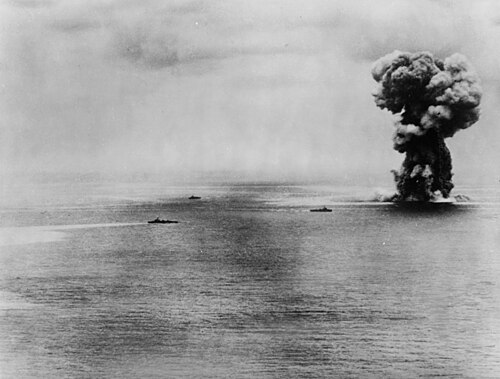
By early 1945, with the Allied invasion of Okinawa imminent, the IJN planned Operation Ten-Go (天一号作戦), a desperate sortie in which Yamato — provided only enough fuel for a one-way voyage — would sail to Okinawa, beach herself, and serve as an unsinkable gun battery. On 6 April 1945 she departed Tokuyama with a small escort force. Detected almost immediately by American submarines and aircraft, she was attacked by approximately 386 carrier-based aircraft from Task Force 58 on 7 April. Sustaining at least 11 torpedo hits and 6 direct bomb hits, her magazines detonated in a catastrophic explosion at around 14:23, visible over 160 kilometers away. Of her crew of 3,332, only 277 survived.
Yamato's wreck was located in 1985 at a depth of approximately 340 meters in the East China Sea, 290 kilometers southwest of Kyushu, split into two main sections by the magazine explosion. The Yamato Museum (大和ミュージアム) in Kure opened in 2005, housing a 1/10 scale model of the ship and extensive artifacts. Yamato has become a symbol of both Japanese military might and the tragedy of war, inspiring the iconic Space Battleship Yamato (宇宙戦艦ヤマト) manga and anime franchise.
Related sites (5)
- Built34.231, 132.565
Kure Naval Arsenal (呉海軍工廠), Hiroshima Prefecture. Construction began November 1937 under extreme secrecy; the entire drydock was covered with rope screens. Launched 8 August 1940, commissioned 16 December 1941.
- Homeport34.241, 132.556
Kure Naval Base (呉鎮守府), Hiroshima. Primary home port and the location of the Yamato Museum (大和ミュージアム) opened in 2005, which houses a 1/10 scale model of the battleship.
- Battle12.117, 122.483
Battle of Sibuyan Sea / Battle off Samar (October 1944), Battle of Leyte Gulf. Yamato was part of Admiral Kurita's Center Force and was hit by two armor-piercing bombs in the Sibuyan Sea but remained battleworthy, briefly engaging American escort carriers at the Battle off Samar.
- Sunk30.367, 128.067
Sunk 7 April 1945 during Operation Ten-Go (天一号作戦), approximately 290 km southwest of Kyushu in the East China Sea. Attacked by ~386 US carrier aircraft from Task Force 58; suffered at least 11 torpedo hits and 6 bomb hits before her magazines exploded at 14:23. Wreck located in 1985 at ~340 m depth, split in two.
- Memorial34.241, 132.556
Yamato Museum (大和ミュージアム / Kure Maritime Museum), Kure, Hiroshima. Opened April 2005. Features a 1/10 scale model of Yamato (26.3 m long), artifacts and documents related to the ship (the anchor and other relics displayed outdoors come from the battleship Mutsu), and extensive exhibits on the ship and wartime Kure.
Images