蒼龍
Carrier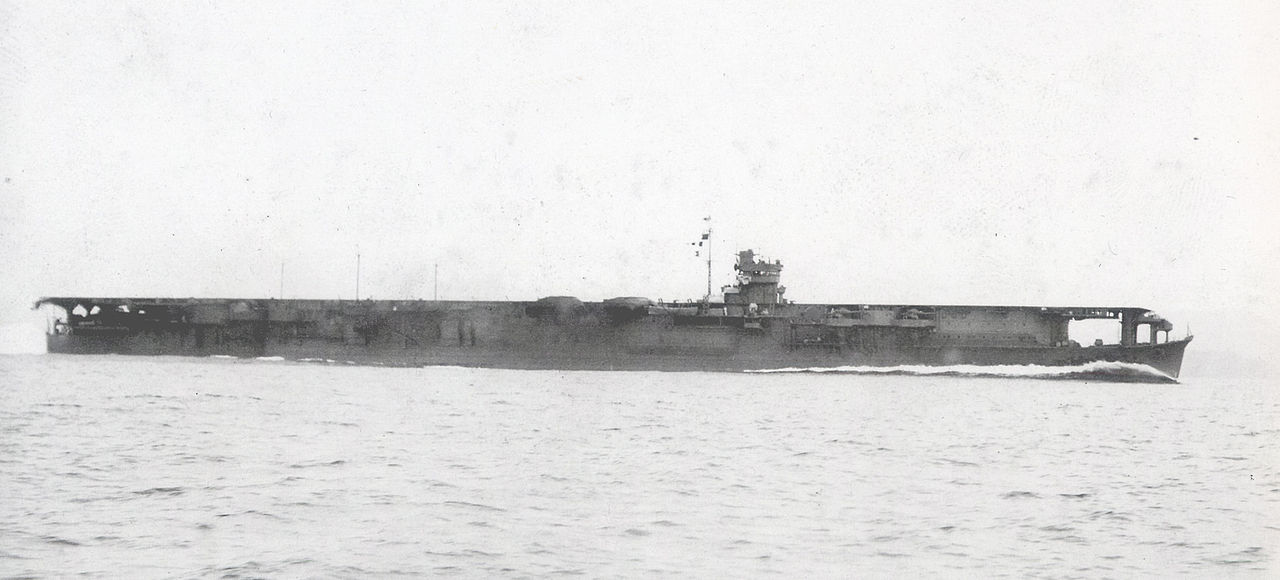
Sōryū was an Imperial Japanese Navy fleet carrier commissioned in 1937, and one of the fastest carriers in the world at the time. She served as a core unit of the Kido Butai and participated in major operations including Pearl Harbor, Wake Island, the Darwin raid, and the Indian Ocean raid. She was sunk on 4 June 1942 at the Battle of Midway by dive bombers from USS Yorktown, with the loss of 711 crew.
- Armament
- 12.7cm連装高角砲6基12門、25mm連装機銃14基28門、艦載機約57機
- Fate
- Sunk in battle
History
Sōryū ("Blue Dragon") was an Imperial Japanese Navy aircraft carrier laid down at Kure Naval Arsenal on 20 November 1934. Launched on 23 December 1935 and commissioned on 29 December 1937, she displaced 16,200 tonnes standard and could reach 34.5 knots, making her the fastest carrier in the world at commissioning. She carried approximately 57 aircraft and was armed with twelve 12.7 cm Type 89 dual-purpose guns and twenty-eight 25 mm anti-aircraft guns.
Sōryū formed the backbone of CarDiv 2 (2nd Carrier Division) of the First Air Fleet — the renowned Kido Butai. She participated in the attack on Pearl Harbor on 7 December 1941, contributing aircraft to both strike waves. In December 1941 she also supported operations against Wake Island. In February 1942, her aircraft joined the devastating raid on Darwin, Australia. During the Indian Ocean Raid in April 1942, her air group played a key role in sinking the British heavy cruisers HMS Cornwall and HMS Dorsetshire.
At the Battle of Midway on 4 June 1942, Sōryū was caught with armed and fueled aircraft in her hangars during a rearming cycle. At approximately 10:25, she was struck by three 1,000 lb bombs dropped by SBD Dauntless dive bombers from USS Yorktown's Bombing Squadron Three (VB-3). The hits caused catastrophic fires and explosions that disabled the ship and killed hundreds of men.
Unable to control the fires, the crew abandoned ship. Captain Ryusaku Yanagimoto refused to leave and was last seen standing on the bridge singing the national anthem. The blazing hulk was finished off by the destroyer Isokaze with torpedoes, and Sōryū sank stern-first at approximately 19:13. She was formally struck from the Navy List on 10 August 1942. Of her crew of approximately 1,103, some 711 perished.
Related sites (4)
- Built34.238, 132.565
Kure Naval Arsenal, Kure, Hiroshima Prefecture. Sōryū was laid down here on 20 November 1934, launched 23 December 1935, and completed 29 December 1937.
- Homeport35.283, 139.667
Yokosuka Naval Base and Hashirajima anchorage (Combined Fleet main anchorage, Hiroshima Bay). Sōryū regularly operated from Yokosuka and the Hashirajima fleet anchorage.
- Training31.350, 130.550
Kagoshima (Kinkō) Bay and Shibushi (Ariake) Bay, Kyushu. The Kido Butai carriers and their air groups trained extensively in southern Kyushu waters — Kinkō Bay, Shibushi Bay and Saeki Bay — before major operations, including rehearsals for the Pearl Harbor attack.
- Sunk30.633, -179.217
Battle of Midway, northwest of Midway Atoll. Sōryū was struck by three 1,000 lb bombs from USS Yorktown's VB-3 dive bombers at 10:25 on 4 June 1942. Fires raged uncontrolled; she was scuttled by destroyer Isokaze and sank stern-first at approximately 19:13. 711 of 1,103 crew were killed, including Captain Ryusaku Yanagimoto.
Images


