Yuanshan Water Shrine
圓山水神社
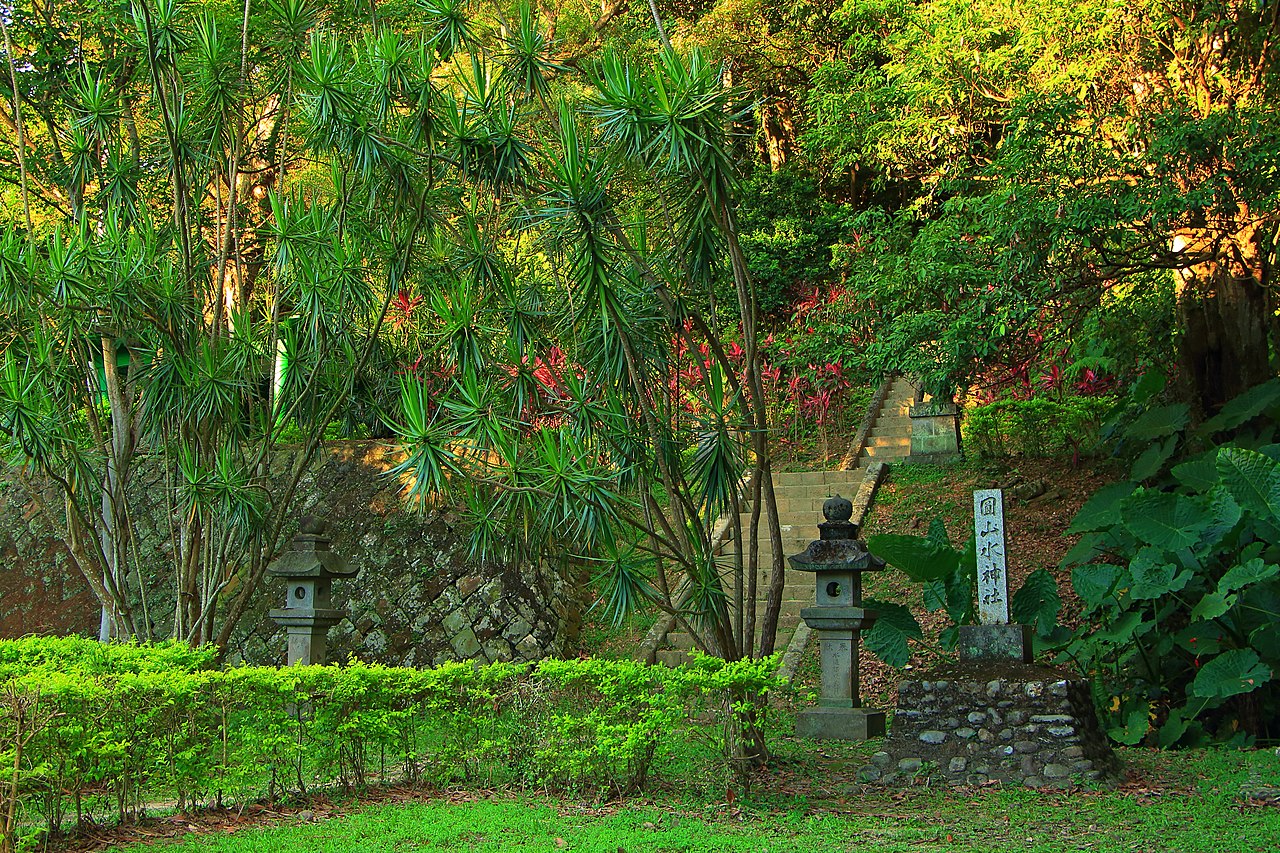
The Yuanshan Water Shrine (Maruyama Suijinja) is a rare, well-preserved Japanese Shinto shrine ruin in Taipei, built in 1938 (Shōwa 13) beside the Yuanshan Reservoir to honor workers who died during the construction of the Grass Mountain Waterworks (Sōzan Suidō), Taipei's second modern water supply system. The site retains stone lanterns (tōrō), guardian lion-dogs (komainu), a purification basin (chōzuya) and the shrine-name stele; the original worship hall has not survived. Constructed through donations from employees of the Taipei Waterworks Department, it served as both a memorial to the fallen engineers and laborers and a spiritual guardian of the water source. The shrine and the broader Grass Mountain Waterworks were designated a Taipei Municipal Historic Site in 2004.
Images


History
The Yuanshan Water Shrine (圓山水神社, Maruyama Suijinja) is one of the best-preserved Japanese Shinto shrine ruins in Taipei, Taiwan. Nestled on a hillside near Jiantan MRT Station and adjacent to the Taipei Water Department's Yangming District Business Office, the shrine stands as a quiet memorial to the workers who sacrificed their lives building Taipei's modern water infrastructure during the Japanese colonial period.
The shrine's origins are tied to the construction of the Grass Mountain Waterworks (草山水道系統, Sōzan Suidō Keitō), Taipei's second major water supply system. By the late 1920s, the city's rapid population growth had outstripped the capacity of the original Gongguan water treatment plant built in 1908. In 1928, the colonial government adopted a design by the engineer Dr. Sano Tōjirō (佐野藤次郎) for a new system that would draw water from springs below Zhuzihu and on the southern slope of Shamao Mountain, channel it through over ten kilometers of pipelines across Shamao Mountain, through the Tianmu Water Pipe Road, past the Sanjiaopuzha Power Station, and into the Yuanshan Reservoir before crossing the Keelung River via the Meiji Bridge (now Zhongshan Bridge) into the city center. Begun in March 1928 and completed in March 1932, this engineering feat delivered 28,800 metric tons of water daily.
The construction of this ambitious system through mountainous terrain came at a human cost. Multiple workers perished during the four-year construction period due to accidents, harsh conditions, and disease. In 1938 (Shōwa 13), employees of the Taipei Waterworks Department (台北水道課) pooled their personal funds to build a Shinto shrine beside the Yuanshan Reservoir. The shrine was dedicated to the Water God (水神, Suijin) and served a dual purpose: to console the spirits of the deceased workers and to provide spiritual protection for the water source that sustained the city.
The shrine was constructed in the traditional Japanese style with a stone torii gate marking the entrance, a path lined with stone lanterns (tōrō) donated by waterworks staff, a purification basin (chōzuya/手水舍) for ritual cleansing, a pair of stone guardian lion-dogs (komainu/狛犬) flanking the approach, and a raised platform where the main hall (haiden) once stood. Inscriptions on several of the stone lanterns record the names of donors from the water department, providing a direct human connection to the shrine's origins.
After Japan's surrender in 1945, most of Taiwan's approximately 200 Shinto shrines were systematically dismantled or converted by the incoming Nationalist government. The Yuanshan Water Shrine, however, survived largely because of its small size, secluded hillside location, and its association with the still-functional water infrastructure rather than with overt political or military symbolism. The shrine fell into neglect for decades until the Taipei Water Department tidied and repaired the grounds, putting up a simple Chinese-style pavilion where the lost worship hall had stood. In August 2017 the site was vandalised with spray paint and one of the stone komainu was stolen. Today the site is maintained, with the stone lanterns, komainu, and shrine platform clearly visible amid carefully tended vegetation. The entire Grass Mountain Waterworks system, including the shrine, was designated a Taipei Municipal Historic Site (市定古蹟) on April 28, 2004, recognized as one of the most complete and still partially operational colonial-era water systems in Taiwan.
Categories
Related themes
Sources
- 草山水道系統(含圓山水神社) - 維基百科Website