Former Nippon Kangyo Bank Headquarters
日本勧業銀行本店跡

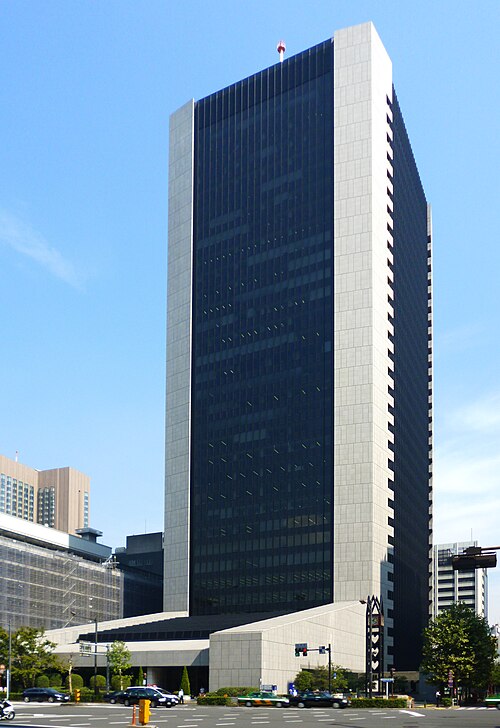
Site of the former headquarters of Nippon Kangyo Bank (日本勧業銀行) in Uchisaiwaicho, Chiyoda Ward, Tokyo. During WWII, the bank served as the central institution for issuing wartime government bonds (戦時公債), lottery-style savings bonds (割増金付戦時債券), and the "Victory Tickets" (勝札) that became the precursor to Japan's modern national lottery (宝くじ). The original Meiji-era building (1899, designed by Tsumaki Yorinaka) was sold and relocated in 1926 and succeeded by a second head office completed in 1929; the site later became the Dai-Ichi Kangyo Bank Head Office Building (1981) and subsequently the Mizuho Bank Uchisaiwaicho Head Office Building, which was demolished in 2022 for redevelopment.
Images



History
The Nippon Kangyo Bank (日本勧業銀行, commonly abbreviated as "Kangin" 勧銀) was established in 1897 (Meiji 30) under the Hypothec Bank Act as a special government-backed financial institution to provide long-term, low-interest loans for the development of agriculture and industry. Its headquarters was located at Uchisaiwaicho, within the Kojimachi Ward (麹町区) of Tokyo — present-day Chiyoda Ward.
The first headquarters building was completed in 1899 (Meiji 32), designed by the renowned architect Tsumaki Yorinaka (妻木頼黄), who also designed the famous Nihonbashi Bridge, with construction supervised by Takeda Goichi (武田五一). The building was a distinctive two-story wooden structure with tile roofing in Japanese architectural style, reflecting the nationalist sentiment of the post-Sino-Japanese War era. The contractor was Okura Doboku (大倉土木, now Taisei Corporation).
As the bank expanded, the original building was sold in 1926 (Taisho 15), and a five-story steel-and-reinforced-concrete head office designed by Watanabe Setsu was completed on the site in 1929. The historic Meiji-era building, sold to Keisei Electric Railway, was relocated to Yatsu, Chiba Prefecture, where it later served as the Chiba City Hall and is now the Chiba Toyopet headquarters — a Registered Tangible Cultural Property since 1997.
During the Second Sino-Japanese War and the Pacific War, Nippon Kangyo Bank became the designated lead underwriting institution for the government's wartime bond program. Under the Temporary Funds Adjustment Act (臨時資金調整法, enacted September 1937), the bank issued a series of increasingly lottery-like financial instruments to mobilize civilian savings for the war effort:
- Savings Bonds (貯蓄債券): First wartime special savings bonds issued in 1942
- Patriotic Bonds (報国債券): 10-yen bonds with lottery prizes up to 10,000 yen, with public drawings
- Special Patriotic Bonds (特別報国債券): Enhanced lottery-style bonds
- Fortune Tickets (福券) and Savings Tickets (貯蓄券): Short-term lottery instruments
- Victory Tickets (勝札, "Kachifuda"): The final wartime issue, sold from July 16, 1945, at 10 yen face value with a top prize of 100,000 yen. Due to material shortages, supplementary prizes of cigarettes and cotton calico cloth were more coveted than the cash. The drawing was scheduled for after Japan's surrender, earning them the satirical nickname "Defeat Tickets" (負札, "Makefuda").
On October 29, 1945, just weeks after Japan's surrender, Nippon Kangyo Bank issued the "First Lottery" (第一回宝くじ), marking the birth of Japan's modern public lottery system. The bank's wartime experience with lottery-bond instruments directly evolved into the peacetime takarakuji (宝くじ) that continues today.
In 1971, Nippon Kangyo Bank merged with Dai-Ichi Bank to form Dai-Ichi Kangyo Bank (第一勧業銀行, DKB), Japan's largest bank at the time. A new 32-story, 140-meter skyscraper designed by Ashihara Yoshinobu Architectural Design Associates and built by Shimizu Corporation was completed on the same site in January 1981 as the DKB Head Office. In 2002, DKB merged with Fuji Bank and the Industrial Bank of Japan to form Mizuho Financial Group, and the building was renamed the Mizuho Bank Uchisaiwaicho Head Office Building. The building closed in October 2021, when its Tokyo business department moved to Otemachi, and it was demolished beginning September 2022 as part of the Uchisaiwaicho 1-chome Block Redevelopment Project.
Categories
Related themes
Sources
- 日本勧業銀行 - WikipediaWebsite
- みずほ銀行内幸町本部ビル - WikipediaWebsite