Former Supreme Military Council Site (Miyakezaka)
旧軍事参議院跡(三宅坂)
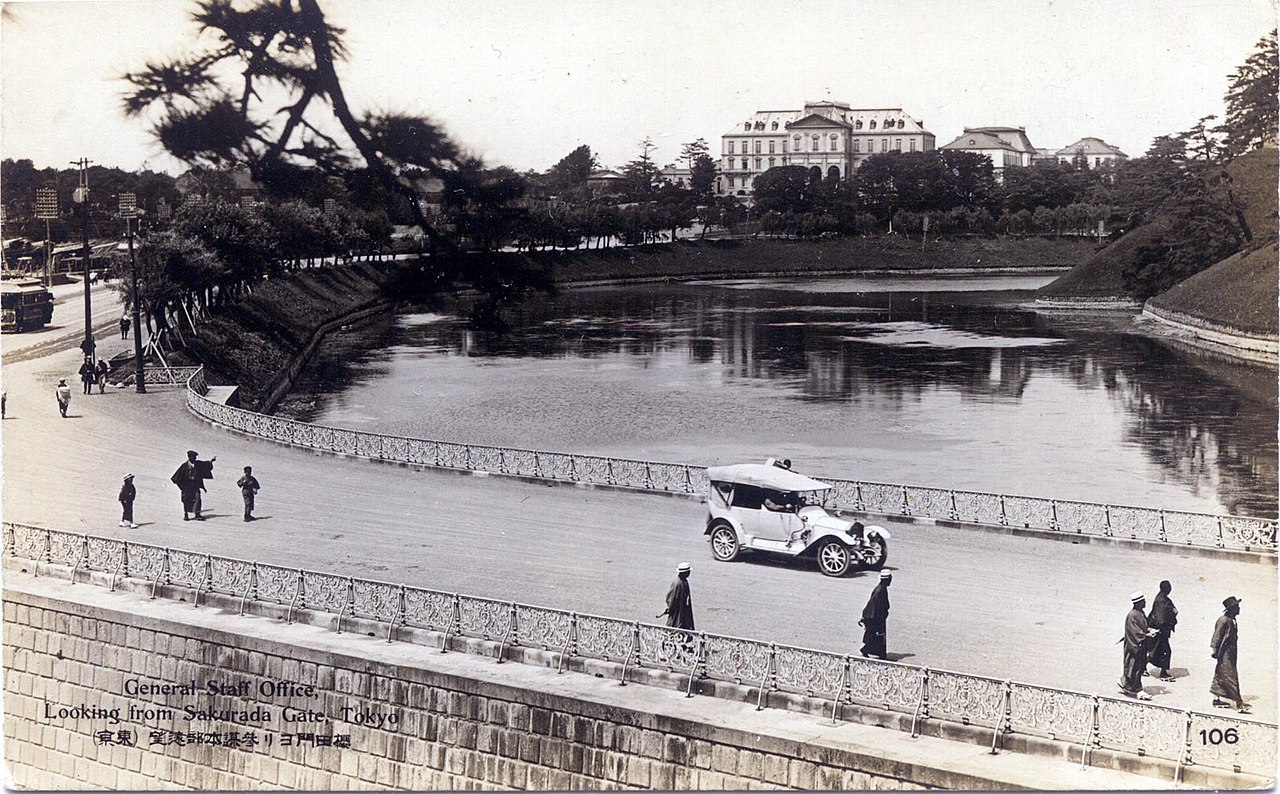
The Supreme Military Council (軍事参議院, Gunji Sangiin) was the highest military advisory body to the Emperor of Japan, established in 1903 at Miyakezaka, Chiyoda-ku, Tokyo, near the Imperial Palace. Comprising senior generals and admirals, it advised on national defense policy and military strategy. Its posts became largely honorary over time, though the councillors retained influence in Army personnel matters, until its abolition in November 1945. The site now houses the National Diet Front Garden and the Kensei Kinenkan (Constitutional Memorial Hall).
Images


History
The Supreme Military Council (軍事参議院, Gunji Sangiin) was established in 1903 as the highest military advisory organ to the Emperor of Japan. Located at Miyakezaka in Chiyoda Ward, Tokyo, directly adjacent to the Imperial Palace moat, the council occupied a strategically significant position at the heart of Japan's military-political center, alongside the Army Ministry (陸軍省) and the Army General Staff Office (参謀本部).
The council was composed of senior military leaders — field marshals, fleet admirals, full generals, and full admirals — who served as Military Councillors (軍事参議官). The council was chaired by its most senior member; Field Marshal Yamagata Aritomo, one of the founders of the modern Imperial Japanese Army and a former Prime Minister, was closely involved in its creation in 1903. The council's mandate was to advise the Emperor on matters of national defense, military organization, and strategic planning. The Army's "Big Three" (三長官) were the Army Minister, the Chief of the General Staff, and the Inspector General of Military Education — not the council's chairman — but the Military Councillors took part in matters such as the selection of the Big Three and the retirement of senior officers, which gave the posts weight in factional politics.
During the 1930s and the Pacific War era, the Supreme Military Council's role evolved as Japan's wartime command structure shifted. From November 1937, following Emperor Shōwa's directives, the council's advisory functions were in practice superseded by the Imperial General Headquarters-Government Liaison Conference (大本営政府連絡会議). In 1944, Prime Minister Koiso further reorganized the top command by establishing the Supreme Council for the Direction of the War (最高戦争指導会議). Nevertheless, the Military Councillors continued to hold enormous personal influence, and the Supreme Military Council remained formally active until Japan's surrender.
The Miyakezaka area where the council was housed had been the military nerve center of the Japanese Empire since the Meiji period. The Army General Staff headquarters, designed by the Italian architect Giovanni Vincenzo Cappelletti, was completed here in 1881. In December 1941, at the outbreak of the Pacific War, the Army Ministry and General Staff relocated from Miyakezaka to the former Imperial Japanese Army Academy site at Ichigaya, but the area's association with military power persisted.
After Japan's defeat in 1945, the Supreme Military Council was abolished along with the rest of the imperial military apparatus. The former military buildings at Miyakezaka were largely destroyed during the Allied bombing of Tokyo. The site was subsequently repurposed as the National Diet Front Garden (国会前庭), whose northern section — the former General Staff and Army Ministry grounds — is a Western-style garden with the landmark clock tower and the Kensei Kinenkan (憲政記念館, Constitutional Memorial Hall), which commemorates the history of Japanese parliamentary democracy. Today, little physical trace of the original military council buildings remains, but the site stands as a powerful reminder of the transformation from militarism to democracy in postwar Japan.
Categories
Related themes
Sources
- 軍事参議院 - Wikipedia(日本語版)Website
- 陸軍三長官 - Wikipedia(日本語版)Website
- 国会前庭(衆議院 憲政記念館)Government