Sup'ung Dam (Suiho Dam)
水豊ダム

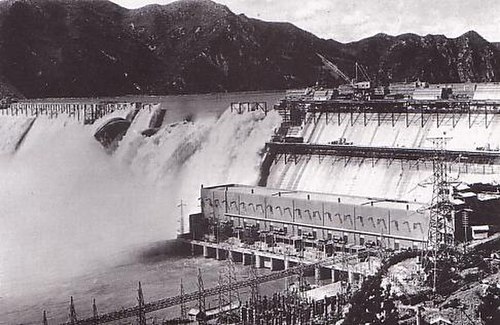
Completed in 1941 on the Yalu River at the China-Korea border, the Sup'ung Dam was the largest hydroelectric dam in Asia and the third largest in the world at the time of construction. Built by two Yalu River hydroelectric companies headed by Noguchi Shitagau of Nichitsu (Japan Nitrogen Fertilizer Company), with its output shared between Korea and Manchukuo, the dam represented one of the greatest engineering achievements of the Japanese Empire. With a planned output of 700,000 kW from seven generating units driven by 105,000 kW Francis turbines, the dam supplied electricity throughout the Korean peninsula and southern Manchuria. During the Korean War, its power station was bombed repeatedly by UN forces in 1952-1953. The dam remains operational today, jointly managed by China and North Korea, and is featured on North Korea's national emblem.
Images


History
The Sup'ung Dam (水豊ダム, also romanized as Suiho Dam) is a massive gravity dam spanning the Yalu River between Kuandian Manchu Autonomous County in Liaoning Province, China, and Sakju County in North Pyongan Province, North Korea. At 106 meters in height and 899.5 meters in length, it was the largest hydroelectric dam in Asia and the third largest in the world when construction was completed.
Construction began in 1937 as a joint venture between Japanese-controlled Manchukuo and the colonial administration of Korea. The project was spearheaded by Noguchi Shitagau (野口遵), the founder of Nichitsu (日本窒素肥料, Japan Nitrogen Fertilizer Company, later known as Chisso), who established two companies for the purpose: the Korean Yalu River Hydroelectric Power Company and the Manchurian Yalu River Hydroelectric Power Company, each capitalized at 50 million yen. The dam required 850,000 tons of concrete and millions of hours of labor, displacing thousands of Korean and Chinese residents in the process.
The dam was designed to house seven generating units with Francis turbines of 105,000 kW each (built by Dengyosha), for a planned output of 700,000 kW. Of the seven 100,000 kVA generators, five were manufactured by Tokyo Shibaura Electric (later Toshiba) and two were ordered from Germany's Siemens. Electricity transmission began in August 1941, with two generators operational. By February 1944, six generators were running, but one Siemens unit never arrived due to wartime disruptions, leaving the wartime capacity at approximately 600,000 kW. The generated power was divided between Manchukuo and Korea — the generators were built for the 50 Hz Manchurian and 60 Hz Korean grids — and was transmitted to southern Manchuria and across the Korean peninsula.
The dam's fortunes changed dramatically at the end of World War II. On August 9, 1945, Soviet forces invaded Manchuria and Korea. Soviet forces subsequently dismantled a number of the generators — five according to Japanese accounts, three (in 1947) according to others — and transported them to the Irtysh River in Kazakhstan, where they were installed in a Soviet hydroelectric facility. This left the plant crippled for years.
During the Korean War, the dam became a strategic target. UN forces mounted three main attacks on the Sup'ung power station: on June 23-24, 1952, when US Navy carrier aircraft and Air Force fighter-bombers dropped more than 200 tons of bombs on the generating facilities; on the night of September 12-13, 1952, when B-29 bombers targeted the power station; and on February 15, 1953, by F-84 fighter-bombers, followed by smaller strikes in May and June 1953. Despite the attacks, the dam's massive concrete structure survived.
The dam was subsequently repaired and expanded. China added two additional 67.5 MW generators in 1987-1988, bringing the total installed capacity to 765 MW. The most recent renovation, a US$24.5 million spillway improvement project, was completed between 2009 and 2011. Today, the dam's power output is split evenly between China and North Korea. The Sup'ung Dam holds deep symbolic significance for North Korea — it is prominently featured on the national emblem of the DPRK, representing the country's industrial aspirations and self-reliance.
Categories
Related themes
Sources
- 水豊ダム - Wikipedia(日本語)Website
- Sup'ung Dam - WikipediaWebsite
- Attack on the Sui-ho Dam - WikipediaWebsite