Taichung Prison Martial Arts Hall
臺中刑務所演武場
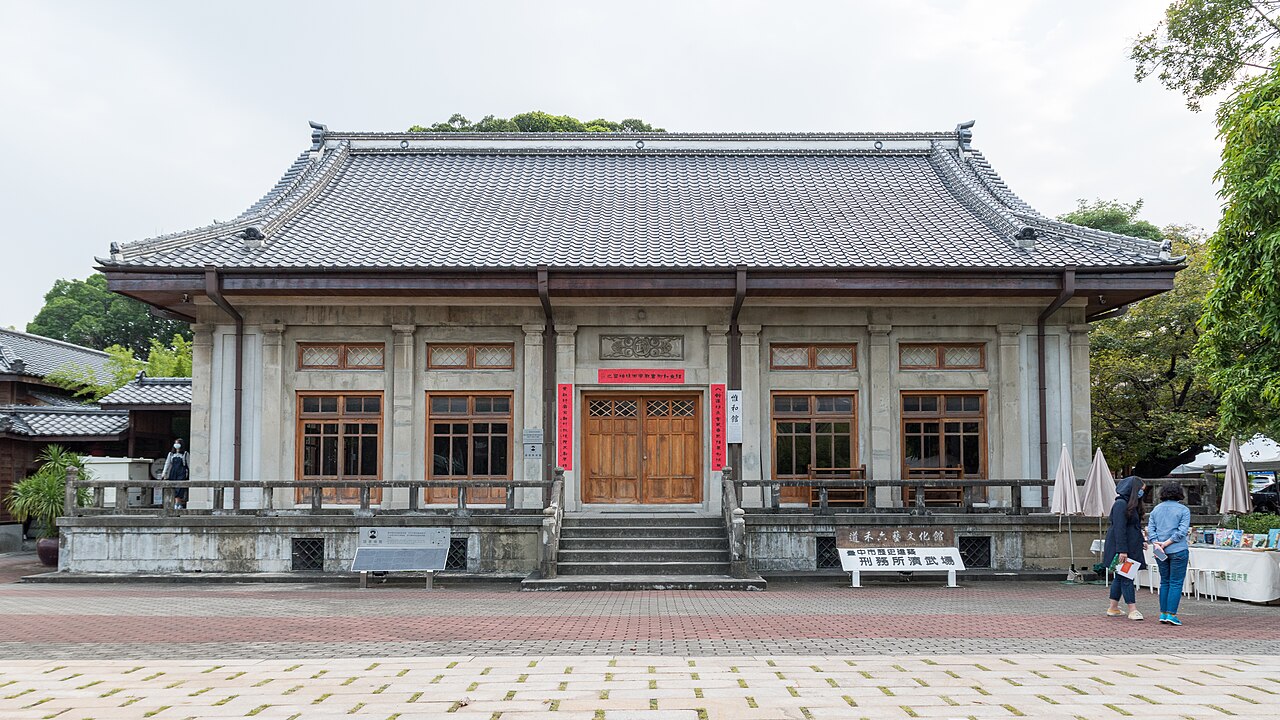
A martial arts training hall (budokan) built in 1937 as part of the Taichung Prison complex during the Japanese colonial period. Used for kendo and judo practice by prison officials and police, it is the only surviving Japanese-era martial arts hall in Taichung. The symmetrical building features a traditional Japanese irimoya-style roof with a central shrine flanked by judo and kendo training areas. After a devastating fire in 2006, it was meticulously restored by 2010 and operated as the Daohe Liuyi Cultural Center from 2012 to 2023.
Images


History
The Taichung Prison Martial Arts Hall (臺中刑務所演武場) is a Japanese colonial-era budokan located at No. 33 Linsen Road in the West District of Taichung, Taiwan. Built in 1937 (Showa 12), it served as the primary martial arts training facility for prison guards (司獄官) and police officers attached to the Taichung Prison (臺中刑務所), which had been established in 1896 during the early years of Japan's colonial administration of Taiwan.
The original first-generation martial arts hall was constructed in 1924, but the current second-generation building was completed on August 16, 1937. The hall was designed in a distinctive Japanese-Western hybrid architectural style (和洋折衷), combining brick construction with traditional Japanese temple design elements. The building features a symmetrical layout with an irimoya-style (hip-and-gable) roof crowned with large decorative roof tiles and bargeboards. The elevated foundation and timber-like facade with pilaster decorations reflect the building's dual cultural heritage. Inside, a central shrine altar (神龕) divided the space, with a judo (柔道) training area to the left and a kendo (劍道) training area to the right.
During the colonial period, the budokan played an important role in the Japanese imperial system of social control in Taiwan. Martial arts training was mandatory for prison guards and police, who were the primary enforcers of colonial authority. The facility represented the Japanese emphasis on bushido-inspired discipline and physical training as essential components of colonial governance. The attached auxiliary buildings on the east side of the complex served additional administrative and support functions for the prison system.
After Japan's surrender in 1945, the building was transferred to the Republic of China government and continued to serve the Ministry of Justice's Taichung Prison. On February 20, 2004, the Taichung City Cultural Bureau registered the martial arts hall as a historic building, recognizing its architectural and historical significance. However, on November 15, 2006, a fire broke out that destroyed much of the wooden structural components, prompting the Cultural Bureau to form an emergency response task force. A painstaking four-year restoration project followed, and the main structure and auxiliary buildings were fully restored by November 2010.
In March 2012, the Taichung City Government entrusted the management of the site to the Daohe Education Foundation, which renamed it the Daohe Liuyi Cultural Center (道禾六藝文化館, Natural Way Six Arts Cultural Center). Under this stewardship, the former martial arts hall was transformed into a cultural learning park offering programs in the six classical Confucian arts: archery, kendo, tea ceremony, calligraphy, music, and mathematics. Operations under the Daohe Foundation ceased on October 31, 2023, and the site is now being replanned as part of the National Comics Museum (國家漫畫博物館) initiative.
Categories
Related themes
Sources
- 臺中刑務所演武場 - 維基百科Website