All historic sites
Sites in the Japanese home islands are shown by default; switch the Region menu to see Taiwan, Korea and Manchuria.
217 sites · page 2 of 10

Former Taipei Army Cemetery (Liuzhangli)
台北陸軍墓地跡(六張犁)
Site of the former Imperial Japanese Army cemetery in the Liuzhangli area of Taipei's Da'an District. Established during the Japanese colonial period to inter soldiers who died in service in Taiwan, the cemetery was part of the broader Liuzhangli burial grounds that served Taipei's Japanese community. After Japan's defeat in 1945, the military graves were largely cleared as part of de-Japanization efforts, with scattered tombstones remaining among the hillside terrain. The area was subsequently incorporated into the Taipei Municipal Cemetery system and later became associated with the burial of White Terror political victims in the 1950s.

Former Taiwan Gokoku Shrine (now National Revolutionary Martyrs' Shrine)
台灣護國神社跡(現・國民革命忠烈祠)
Site of the Taiwan Gokoku Shrine (台灣護國神社), established in 1942 at Dazhi (大直) in Taipei, just east of the Taiwan Shrine's new precinct near Yuanshan (圓山), to enshrine the Taiwan-related war dead already enshrined at Tokyo's Yasukuni Shrine — those who died in Taiwan and people from or resident in Taiwan who died in Japan's service. Part of the nationwide gokoku jinja (護國神社) system created under rising wartime militarism to memorialize the war dead. After Japan's defeat, the ROC government converted the shrine in 1946 into the Taiwan Provincial Martyrs' Shrine. In 1969, under President Chiang Kai-shek's direction, the site was completely rebuilt in Chinese palatial style modeled after Beijing's Hall of Supreme Harmony, becoming the National Revolutionary Martyrs' Shrine (國民革命忠烈祠), dedicated to roughly 400,000 ROC soldiers and civilians (published figures range from about 390,000 to over 400,000) who died in conflicts from the Xinhai Revolution through the Taiwan Strait crises.

Former Taiwan Provincial Administrative Executive Office (now Executive Yuan)
台湾省行政長官公署跡(現・行政院)
Built between 1937 and 1940 as the Taipei Municipal Office during the Japanese colonial period, this building became the headquarters of the Taiwan Provincial Administrative Executive Office (台灣省行政長官公署) after Japan's surrender in 1945. Under Chief Administrator Chen Yi, it served as the highest governing authority during the turbulent postwar transition. On February 28, 1947, protesters marching to this building were fired upon by guards, a pivotal moment in the February 28 Incident (228事件) that triggered island-wide unrest. The building later housed the Taiwan Provincial Government and has served as the Executive Yuan (行政院) of the Republic of China since 1957. Designated a national historic site in 1998, it remains one of the most significant colonial-era government buildings in Taiwan.

Governor-General's Residence (Taipei Guest House)
台湾総督官邸(台北賓館)
Built in 1901 as the official residence of the Governor-General of Taiwan during Japanese colonial rule, this Baroque-style mansion served as the venue for official receptions and state ceremonies. After WWII, the Treaty of Taipei was signed here in 1952, and it is now a designated national historic monument known as the Taipei Guest House.

Grand Hotel Taipei (Former Taiwan Grand Shrine Site)
圓山大飯店(台湾神宮跡地)
The Grand Hotel Taipei is a landmark Chinese palace-style hotel established in 1952 on the former site of the Taiwan Grand Shrine (臺灣神宮) in Zhongshan District, Taipei. Championed by Madame Chiang (Soong Mei-ling), the hotel stands on the site of the demolished Shinto shrine and is often read as a symbol of the regime change from Japanese colonial rule to the Republic of China. Designed by architect Yang Cho-cheng, the iconic 87-metre vermilion main building with dragon motifs was completed on Double Tenth Day (October 10) 1973. Remnants of the shrine era — including stone walls, foundations, and komainu guardian lion-dogs — survive in the surrounding grounds.

Hobe Fort (Huwei Fort / Tamsui Fort)
滬尾砲台(淡水砲台)
A late-Qing coastal defense fort in Tamsui, New Taipei, built in 1886 under Governor Liu Mingchuan after the Sino-French War. Featuring 4.3-metre-thick iron-cement walls, Armstrong and Krupp breechloaders, and the calligraphic gate inscription "北門鎖鑰" (Key to the Northern Gate), the fort never saw combat. After Japan took Taiwan in 1895, the Imperial Japanese Army removed all four cannons and converted the site into an artillery training ground. The fort remained under military control throughout the colonial period, preserving its structure. Designated a National Monument (國定古蹟) in 1985, it is today one of the best-preserved Qing-era forts in Taiwan.

Hsinchu Air Raid Site
新竹空襲跡
Site commemorating the first American air raid on Taiwan, on November 25, 1943, when 14 B-25 bombers of the US 14th Air Force and the Chinese-American Composite Wing struck Hsinchu from bases in China, claiming some 50 Japanese aircraft destroyed (Japanese records admit far fewer) and marking the beginning of Allied strategic bombing of Formosa.

Hsinchu Shrine Ruins
新竹神社跡
Hsinchu Shrine (新竹神社, Shinchiku Jinja) was the largest and highest-ranked Shinto shrine in colonial Shinchiku Prefecture, Taiwan. Completed in 1918 and elevated to Kokuhei Shosha (國幣小社) in 1942 — the first shrine in Taiwan to receive this national rank — it stood on the slopes of Niupushan (牛埔山) in northern Hsinchu City. After Japan's defeat the site passed to military use, and from 1992 to 2018 it housed a detention and processing centre for unauthorised entrants from mainland China (新竹靖廬). Today it is one of Taiwan's best-preserved Japanese shrine ruins, designated a Hsinchu City Monument in 2001, and a phased restoration project is under way.

Hualien Harbor Airfield (Karenko Airfield)
花蓮港飛行場
A major Imperial Japanese Army airfield on the east coast of Taiwan, established in 1936 as a dual military-civil airfield. During the final months of WWII, it served as one of Taiwan's principal kamikaze staging bases for Operation Ten-Go (天號作戰). Between April and July 1945, eleven kamikaze sorties launched from Hualien, sending 25 special attack pilots on one-way missions against Allied forces at Okinawa — by some accounts second only to Hakkachō Airfield in total kamikaze departures from Taiwan. The site is now ROCAF Hualien Air Base.

Hualien Port
花蓮港
A major port on the east coast of Taiwan constructed by the Japanese colonial government between 1931 and 1939. Originally built as a commercial harbor using innovative land-excavation engineering, it was converted to military use during WWII for naval logistics and resource shipment, and was heavily damaged by Allied air raids in 1945.
Japan Aluminum Hualien Port Factory
日本アルミニウム花蓮港工場
A wartime aluminum smelting factory established in Hualien, Taiwan by Nippon Aluminium Co. (日本アルミニウム株式会社) in the late 1930s. Powered by hydroelectric stations on the Mugua River (木瓜溪), later joined by the Liwu River (立霧溪) station, the plant produced aluminum ingots for Imperial Japan's military aircraft production until it was destroyed by American air raids in 1945.

Kagi Airfield (Chiayi Air Base)
嘉義飛行場
A Japanese Army airfield established in 1936 in Kagi (Chiayi), southern Taiwan (Formosa), as the base of the Army's 14th Air Regiment. From early 1944 through August 1945, it was repeatedly targeted by USAAF and USN air raids, including B-29 strategic bombing from Chengdu and carrier strikes during the Formosa Air Battle. The site is now the Republic of China Air Force Chiayi Air Base, home to the 4th Tactical Fighter Wing equipped with F-16V fighters.
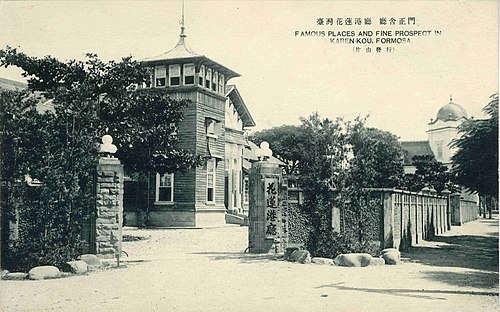
Karenko Prefectural Government Office Site
花蓮港庁舎跡
The Karenko (花蓮港) Prefectural Government Office was the highest administrative authority for the Hualien area of eastern Taiwan during the Japanese colonial period. Established in 1909 when Taiwan was reorganized from twenty to twelve prefectures, the office oversaw a vast mountainous territory corresponding to present-day Hualien County; Taitung remained a separate prefecture. The original wooden building was destroyed by fire in 1910 and rebuilt as a Japanese-Western hybrid structure. A modernist concrete building replaced it around 1936. After Japan's surrender in 1945, the building served as the Hualien County Government headquarters until earthquake damage forced relocation to the current Meilun district site.

Keelung Fortress Command Headquarters
基隆要塞司令部
Command headquarters of the Keelung Fortress (基隆要塞), the highest military command center for coastal defense in northern Taiwan during Japanese colonial rule. Established in 1903, the fortress command oversaw battery positions across the Keelung, Jinshan, Tamsui, Hsinchu, and Houlong areas. The current reinforced concrete headquarters building was completed in 1929, designed by Governor-General's Office architect Asai Shin'ichi. During WWII, the command directed the Keelung Fortress Heavy Artillery Regiment and coordinated air defense during the 1944 Taiwan Air Battle. Designated a Keelung municipal historic site in 2010 and restored for public access in 2022.

Keelung Shipyard (Taiwan Dock Co.)
基隆船渠(台湾船渠株式会社)
Founded in 1919 as Keelung Dock Co. (基隆船渠株式會社) by industrialist Kimura Kyūtarō, then reorganized in 1937 as Taiwan Dock Co. (臺灣船渠株式會社) with Mitsubishi Heavy Industries and major Japanese capital groups. Located on Sheliao Island (社寮島, now Heping Island) in Keelung, it was colonial Taiwan's foremost modern shipbuilding and ship-repair facility. During the Pacific War, the yard served as a critical repair depot for Imperial Japanese Navy warships operating in the South Seas theater. Allied air raids in 1945 heavily damaged the facility and surrounding port.

Kinkaseki POW Camp (Jinguashi Allied POW Memorial Park)
金瓜石捕虜収容所
The Kinkaseki Prisoner of War Camp was one of the most brutal Japanese POW camps in colonial Taiwan (Formosa), operational from November 1942 to March 1945 at Kinkaseki (present-day Jinguashi), Ruifang District, New Taipei City. Over 1,100 British Commonwealth and Allied prisoners — predominantly British, with Australian, Canadian, Dutch, and American servicemen — were forced to perform gruelling slave labour deep inside the adjacent copper mine under extreme conditions including temperatures exceeding 40°C, starvation rations, frequent beatings, and no safety provisions. Of the approximately 430 Allied POW deaths across all fourteen Japanese camps on Taiwan, the majority occurred at Kinkaseki. The camp closed in March 1945 when Allied naval interdiction made ore shipment to Japan impossible, and surviving prisoners were relocated to Kukutsu camp. The site lay forgotten until its rediscovery in 1990. On 23 November 1997, an international memorial was dedicated on the original camp grounds, and in 2011 a bronze "Mates" sculpture depicting two emaciated prisoners was unveiled. The memorial park — now known as the Taiwan POW Memorial and Peace Park — includes a 56-foot Wall of Names listing all POWs by rank and origin.

Kokan Airfield (Ching Chuan Kang Air Base Predecessor)
公館飛行場(清泉崗基地前身)
Imperial Japanese Navy airfield built on the Dadu Plateau in Taichung, central Taiwan. Originally constructed in 1936 (it was also known as Toyohara Airfield), the facility was requisitioned and expanded by the Navy in 1943 as Kokan Airfield (公館飛行場). By 1944 a satellite runway to the west was under construction. The base was attacked by US Navy carrier aircraft on January 3, 1945. After the war, the site was massively expanded as Kung Kuan Air Base, renamed Ching Chuan Kang (CCK) in 1966, and served as one of the largest US Air Force bases in the Far East during the Vietnam War era. It is now shared between the ROCAF 3rd Tactical Fighter Wing and Taichung International Airport.

Longshan Temple (Taipei Air Raid Site)
艋舺龍山寺(台北大空襲被災)
The historic Longshan Temple in the Wanhua (Manka) district, originally built in 1738, suffered devastating damage during the May 31, 1945 Taipei Air Raid. The main hall and left corridor were completely destroyed. However, the Guanyin Bodhisattva statue miraculously survived unscathed on its lotus pedestal, becoming a powerful symbol of spiritual protection. The temple was rebuilt and rededicated in 1959.

National Taiwan Museum (Former Taiwan Governor-General Museum)
国立台湾博物館(旧台湾総督府博物館)
Taiwan's oldest museum, founded in 1908 by the Japanese colonial government as the Taiwan Governor-General's Museum (臺灣總督府民政部殖產局附屬博物館) to commemorate the completion of the North-South Railway. The current Renaissance-style building, designed by architects Nomura Ichirō and Araki Eiichi, was completed in 1915 within Taihoku New Park (now 228 Peace Park). It served as the colony's foremost cultural and scientific institution throughout the Japanese era.

Old Kaohsiung Station Building
高雄驛(旧駅舎)
The Old Kaohsiung Station, completed in 1941 by Shimizu Corporation in the Imperial Crown Style (帝冠様式), is one of the finest examples of Japanese colonial railway architecture in Taiwan. During WWII it served as a critical military transportation hub for southern Taiwan, facilitating troop and supply movements for the Japanese Imperial forces. The 2,500-tonne building was moved 82.6 meters in 2002 to accommodate railway underground construction, then returned to its original location in 2021 as the centerpiece of the new Kaohsiung Main Station complex.

Penghu Xiyu Battery Group (Xiyu East Fort & West Fort)
澎湖西嶼砲台群(西嶼東臺・西台古堡)
Paired Qing Dynasty coastal batteries on Xiyu (Fisherman Island) in the Penghu Archipelago, guarding the Taiwan Strait. Xiyu West Fort (西台古堡, completed 1889) is the largest and best-preserved historic battery in Penghu at about 8 hectares, with massive tunnel networks concealed within basalt cliffs and four Armstrong breech-loading cannons. Xiyu East Fort (西嶼東臺, completed 1889) is a smaller, roughly rectangular work of about 1.3 hectares with three gun emplacements. Both were built under Governor Liu Mingchuan after the Sino-French War of 1885, reinforced during Japanese colonial rule from 1896 as part of the Penghu Island Fortress (澎湖島要塞) system, and served through the Pacific War. Designated National Historic Monuments (國定古蹟).

Pingtung Airfield (Pingtung Air Force Base)
屏東飛行場(屏東空軍基地)
A major Imperial Japanese Army air base in colonial Taiwan, established in 1920 as the island's first airfield. Originally used for aerial policing of indigenous areas, it became a full military base in 1927 when the IJA 8th Air Regiment relocated from Tachiarai, Kyushu. The two-field complex served as a critical staging point for Japan's southern advance and was repeatedly bombed by USAAF B-29s and carrier aircraft in 1944-1945. Now the ROCAF's Pingtung Air Force Base (north and south fields); civil flights from the north field ended in 2011.

Remains of Taipei Prison (Huaguang Community Ruins)
台北刑務所跡(華光社区遺構)
The Taipei Prison (臺北刑務所, Taihoku Keimushō) was a major colonial detention facility built by the Japanese Government-General of Taiwan around 1904, modeled on European radial prison designs. Located around present-day Jinshan South Road in Taipei, it served as the primary incarceration site for political prisoners throughout the Japanese colonial period (1895–1945). Following the 1923 "Police Incident" (治警事件), prominent anti-Japanese activists including Chiang Wei-shui (蔣渭水), Lin Youchun (林幼春), Tsai Pei-huo (蔡培火), and Lai He (賴和) were imprisoned here. During WWII, the prison also held captured Allied airmen — on June 19, 1945, fourteen American airmen were executed there after a perfunctory trial, just 57 days before Japan's surrender. After the war, the prison grounds became government dormitories known as the Huaguang Community (華光社區). Sections of the original stone prison wall survive along Jinshan South Road: a north wall of about 90 meters, designated a Taipei City monument in 1998, and a south wall designated in 2013. The walls were constructed using stones recycled from the dismantled Qing Dynasty Taipei City Wall.

Rinzai Gokoku Zen Temple (Linji Huguo Chan Temple)
臨濟宗護國禪寺(鎮南山護國禪寺)
The largest surviving Japanese Buddhist temple from the colonial era in Taiwan, originally built in 1900-1912 as Chin'nanzan Gokoku-ji by order of Governor-General Kodama Gentaro. The temple served as a "nation-protecting" (護國) prayer site for the Japanese Empire and housed the headquarters of the Rinzai Zen school in Taiwan. Its main hall (大雄寶殿) is one of the few remaining Japanese-period wooden Buddhist halls in Taiwan, now designated a Taipei municipal historic monument.