All historic sites
Sites in the Japanese home islands are shown by default; switch the Region menu to see Taiwan, Korea and Manchuria.
15 sites

Busan Port (Kanpu Ferry Terminal)
釜山港(関釜連絡船発着地)
Busan Port was the Korean terminus of the Kanpu (関釜) Ferry route connecting Shimonoseki, Japan to colonial Korea. Opened in 1905, the ferry service became a critical artery of Japan's colonial empire, transporting troops, settlers, and — most notoriously — hundreds of thousands of forcibly mobilized Korean laborers to wartime Japan between 1939 and 1945. The port's piers (1st through 4th and central) were built between 1912 and 1943 to handle growing military and commercial traffic. The Konron Maru, a Kanpu ferry, was sunk by the USS Wahoo in October 1943 with 583 casualties. By June 1945, Allied mining of the Korea Strait and air raids effectively shut the route down. Today the site is a modern international ferry terminal, and the National Memorial Museum of Forced Mobilization under Japanese Occupation stands in nearby Busan as a testament to the port's dark wartime legacy.

Chōsen Shrine (Site of)
朝鮮神宮
The Chōsen Shrine (朝鮮神宮, Chōsen Jingū) was the highest-ranking Shinto shrine in colonial Korea, constructed atop Namsan Mountain in Seoul (then Keijō) and completed in 1925. Enshrining Amaterasu Ōmikami and Emperor Meiji, it served as the spiritual centrepiece of Japanese imperial assimilation policy, with compulsory worship enforced during the Asia-Pacific War. Demolished in October 1945 following liberation, the site is now part of Namsan Park, where the Patriot An Jung-geun Memorial Hall was built in 1970.

Former Bank of Chosen Headquarters (Bank of Korea Money Museum)
朝鮮銀行本店跡(韓国銀行貨幣博物館)
The former headquarters of the Bank of Chosen (朝鮮銀行), the central bank of colonial Korea, completed in 1912 in Seoul's Jung-gu district. Designed by Tatsuno Kingo — the architect of Tokyo Station and the Bank of Japan — in a French Renaissance-inspired eclectic style with granite walls, the building served as the nerve center of Japan's colonial monetary system, issuing currency and financing Japanese enterprises across Korea and Manchuria. Heavily damaged during the Korean War, it was restored in 1958 and designated National Historic Site No. 280 in 1981. The Bank of Korea relocated in 1987, and the building reopened in 2001 as the Bank of Korea Money Museum (韓國銀行貨幣博物館), preserving one of the finest examples of Japanese colonial architecture on the Korean Peninsula.

Government-General of Korea (Gyeongbokgung, Seoul)
朝鮮総督府跡(ソウル景福宮)
The Government-General of Korea (朝鮮総督府) building, completed in 1926, served as the headquarters of Japanese colonial rule over Korea from 1926 to 1945. Designed by German architect Georg de Lalande and completed by Japanese architect Ichiro Nomura, the massive Neo-Renaissance structure was built directly in front of the main halls of Gyeongbokgung Palace — a siting widely regarded in Korea as intended to symbolize Japanese dominion and to disrupt the palace's geomantic (feng shui) alignment. After serving as the seat of the US military government, the South Korean National Assembly, and later the National Museum, the building was controversially demolished in 1995-1996 as part of a national effort to erase symbols of Japanese imperialism. The dome cupola was preserved and is now displayed at the Independence Hall of Korea in Cheonan.

Jinhae Guard District (Chinkai Naval Base)
鎮海警備府
The Imperial Japanese Navy's largest naval base on the Korean Peninsula, established in 1904 during the Russo-Japanese War on Jinhae Bay. Elevated to Guard District (警備府) status in November 1941, it served as a key operational hub for naval operations in the Sea of Japan and Korea Strait throughout the Pacific War. The site remains a major Republic of Korea Navy base.

Seodaemun Prison History Hall
西大門刑務所(ソウル西大門区)
Seodaemun Prison (서대문형무소) was built by the Japanese colonial government in 1908 as Gyeongseong Prison, one of the first modern prisons on the Korean Peninsula. Throughout the Japanese occupation (1910–1945), it served as the primary facility for imprisoning, torturing, and executing Korean independence activists and political dissidents. Notable prisoners included Yu Gwan-sun, who died from torture in 1920 at age 17 after leading protests during the March First Movement, as well as Kim Ku and Ahn Chang-ho. Following the March First Movement of 1919, the prison held approximately 3,000 activists simultaneously. After Korea's liberation in 1945, the prison continued to operate under successive South Korean governments until its closure in 1987. In 1992, Seodaemun Independence Park was established on the grounds, and in 1998 the remaining structures were opened as the Seodaemun Prison History Hall. Eleven of the original 98 buildings are preserved, including underground cells, torture chambers, an execution building, and a watchtower.

Yongsan Garrison
龍山基地
Yongsan Garrison in Seoul was the principal Imperial Japanese Army base on the Korean Peninsula, home from 1908 to the headquarters of the Korea Garrison Army and its successor the Korea Army (朝鮮軍). Established during the Russo-Japanese War when Japan purchased approximately 3 million tsubo of land in Yongsan, the base became the nerve center of Japanese military control over Korea throughout the colonial period (1910-1945). After Japan's defeat, U.S. Army forces of the 7th Infantry Division occupied the garrison in September 1945. It subsequently served as the headquarters of United States Forces Korea (USFK) and the U.S. Eighth Army for over seven decades. As of 2018, USFK relocated to Camp Humphreys in Pyeongtaek, and the roughly 2.5 km² site — which still contains many Japanese-era brick buildings — is being returned to South Korea for conversion into a major public park.

Gunsan Japanese Quarter (Gunsan, North Jeolla Province)
群山日本人街(全羅北道群山市)
One of the best-preserved Japanese colonial-era townscapes in Korea, located in Gunsan City, North Jeolla Province. Developed as a major rice export port under Japanese rule from the late 19th century, Gunsan retains a remarkable concentration of colonial-era architecture including the Hirotsu House (dated variously to c. 1925 or the 1930s), the former Gunsan Customs House (1908), and Dongguksa Temple — the only surviving Japanese-style Buddhist temple in Korea. The Japanese concession area featured a Western-grid street plan with 92 subdivided plots. Under the slogan "Time travel back to the 1930s," Gunsan has become a major heritage tourism destination.

Hungnam Nitrogen Fertilizer Factory (Chosen Nitrogen Fertiliser Complex)
興南窒素肥料工場
A massive chemical-industrial complex built by Japan Nitrogenous Fertilizer Company (Nichitsu/Chisso) in Hungnam, colonial Korea, beginning in 1927. At its peak it employed 45,000 workers across a 19.8-million-square-meter site, producing ammonium sulfate (world's third-largest capacity at 500,000 tons/year), explosives, synthetic fuels, and other chemicals for Japan's war effort. Powered by 12 hydroelectric stations generating 870,000 kW — including the Changjin (Chosin) Reservoir system — the complex ranked among the largest chemical-industrial complexes in the Japanese empire.

Incheon Port (Jinsen)
仁川港
Incheon Port was the principal colonial trade gateway to Seoul during the Japanese occupation of Korea (1910–1945). Opened as a treaty port in 1883, it witnessed Japan's military landings during the Sino-Japanese War (1894) and the Russo-Japanese War (1904), and was developed into a major hub for heavy industry and munitions production during WWII. The Open Port Area in Jung-gu retains significant Japanese colonial-era architecture, including former bank buildings and the Nippon Yusen shipping office.
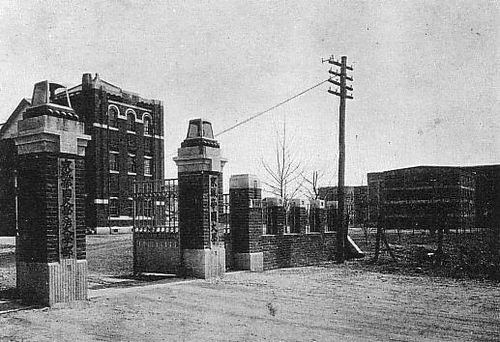
Keijo Imperial University Site
京城帝国大学跡
Site of Keijo Imperial University (1924–1946), the only imperial university established in colonial Korea. Founded as Japan's sixth imperial university in the Dongsung-dong area of Jongno-gu, Seoul, it comprised faculties of Law and Literature, Medicine, and Engineering. The institution served colonial administration and wartime research needs before being reorganized into Seoul National University in 1946.

Korean Women's Volunteer Labor Corps Memorial (Gwangju)
朝鮮女子勤労挺身隊関連跡(光州)
Memorial and documentation site in Gwangju, South Korea, commemorating the Korean Women's Volunteer Labor Corps (朝鮮女子勤労挺身隊). In 1944–45, young Korean girls — some in their early teens — were recruited through schools and local officials in the Gwangju and South Jeolla region to work in Japanese munitions factories, most notably the Mitsubishi aircraft works in Nagoya; survivors say the promised wages and schooling never materialised. A Statue of Peace (平和の少女像) stands near Gwangju City Hall, and the Gwangju-based Citizens' Group with the Women's Volunteer Labor Corps Grandmothers (근로정신대 할머니와 함께하는 시민모임), founded in 2009, continues to advocate for the victims' recognition and reparations.

Nippon Steel Kenjiho Steelworks (Songnim)
日本製鐵兼二浦製鐵所
One of the largest integrated steelworks in colonial Korea, originally built by Mitsubishi Steel in 1918 in Kenjiho (present-day Songnim, North Korea). Absorbed into Nippon Steel in 1934, the plant operated three blast furnaces producing 350,000 tons of pig iron annually. It supplied structural steel, shipbuilding plate, and low-phosphorus pig iron to the Imperial Japanese Navy, including Kure Naval Arsenal. Operations ceased on August 27, 1945.

Sup'ung Dam (Suiho Dam)
水豊ダム
Completed in 1941 on the Yalu River at the China-Korea border, the Sup'ung Dam was the largest hydroelectric dam in Asia and the third largest in the world at the time of construction. Built by two Yalu River hydroelectric companies headed by Noguchi Shitagau of Nichitsu (Japan Nitrogen Fertilizer Company), with its output shared between Korea and Manchukuo, the dam represented one of the greatest engineering achievements of the Japanese Empire. With a planned output of 700,000 kW from seven generating units driven by 105,000 kW Francis turbines, the dam supplied electricity throughout the Korean peninsula and southern Manchuria. During the Korean War, its power station was bombed repeatedly by UN forces in 1952-1953. The dam remains operational today, jointly managed by China and North Korea, and is featured on North Korea's national emblem.

Wonsan Port (Genzan)
元山港
A major port on Korea's east coast during the Japanese colonial period, Wonsan (Genzan) served as both a commercial hub for Sea of Japan trade and a key Imperial Japanese Navy facility. It was the original home base of the Genzan Naval Air Group (元山海軍航空隊), established in 1940, which conducted some of the war's most consequential naval air operations including the sinking of HMS Prince of Wales and HMS Repulse.