Former Army General Staff Office Site
旧陸軍参謀本部跡
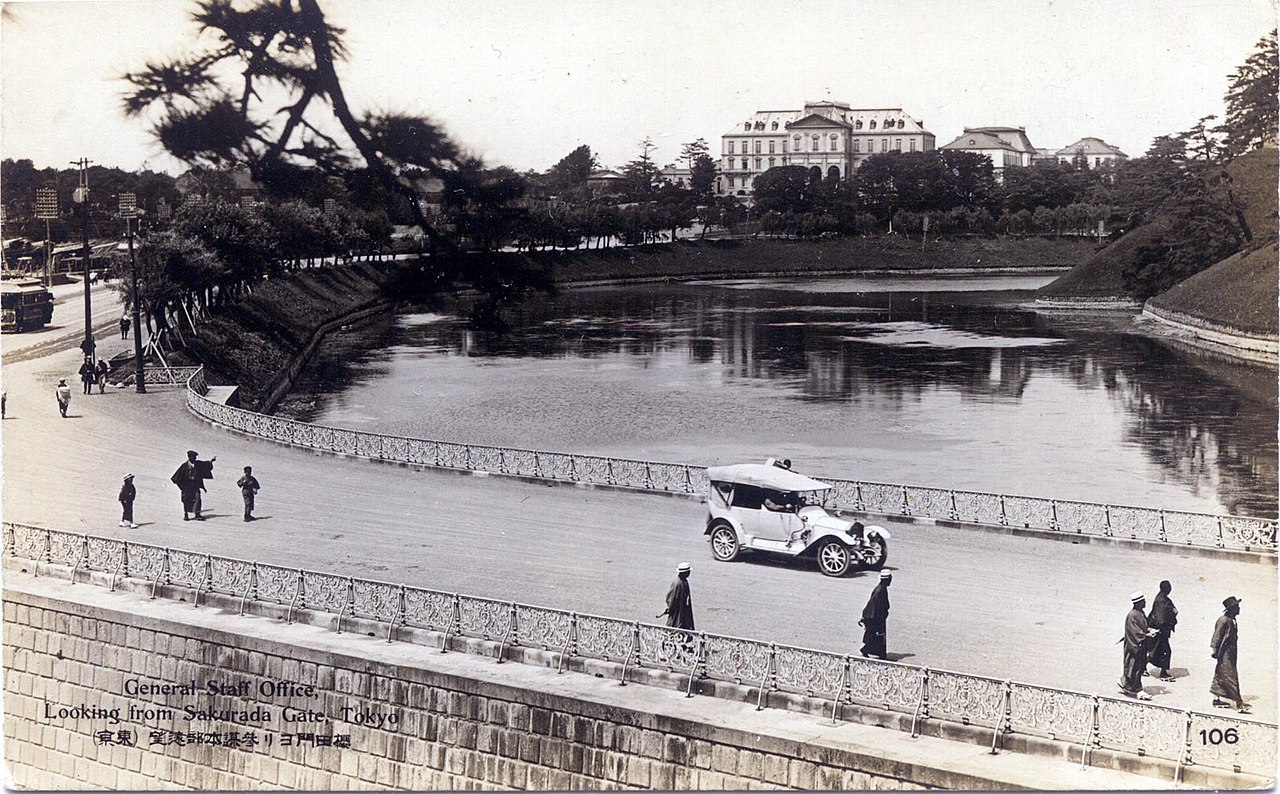
The Imperial Japanese Army General Staff Office (参謀本部, Sanbō Honbu) stood at Miyakezaka, Nagatacho, Chiyoda Ward — the nerve center of all Army operational planning from 1878 to 1941. Designed by Italian architect Giovanni Vincenzo Cappelletti, the Renaissance-style red-brick headquarters was completed in 1881 on the former Ii clan estate overlooking the Imperial Palace moat. Distinct from the Army Ministry (陸軍省) which handled administration, the General Staff held supreme command authority over war plans, intelligence, troop deployments, cartography, and military operations. In December 1941, the General Staff relocated to the Ichigaya compound; the Miyakezaka building was destroyed by Allied bombing in 1945. The site is now occupied by the National Diet Forecourt (国会前庭) and the former Kensei Kinenkan (憲政記念館) area.
Images


History
The Imperial Japanese Army General Staff Office (参謀本部, Sanbō Honbu) was established on December 5, 1878, as an independent organ directly subordinate to the Emperor, separate from the Army Ministry (陸軍省). While the Army Ministry handled administrative and budgetary matters, the General Staff held exclusive authority over operational command — war planning, military intelligence, troop deployment orders, combined-arms training doctrine, field regulations, military cartography, and the compilation of campaign histories.
The General Staff headquarters was built at Miyakezaka (三宅坂) in Nagatacho, Chiyoda Ward, on the elevated plateau of the former upper mansion (上屋敷) of the Ii clan of Hikone Domain. The original building was designed by Giovanni Vincenzo Cappelletti (1843–1887), an Italian architect employed by the Army Ministry, and completed in 1881 (Meiji 14) as a three-story Renaissance-style red-brick structure. Viewed from Sakuradamon Gate across the Imperial Palace moat, the building presented an imposing Western facade symbolizing Japan's military modernization.
The 1894 Meiji Tokyo Earthquake damaged the original structure, prompting construction of a new annex to the north, completed in 1898. The General Staff compound at Miyakezaka grew to encompass multiple buildings alongside the adjacent Army Ministry, forming the military command center colloquially known simply as "Miyakezaka" (三宅坂) — much as "the Pentagon" denotes the U.S. Department of Defense.
During the era of Imperial General Headquarters (大本営, established 1937), the General Staff at Miyakezaka served as the operational brain for Japan's campaigns in China and subsequently across the Pacific. Key wartime Chiefs of Staff including Sugiyama Hajime and Umezu Yoshijirō directed operations from this site.
On December 8–15, 1941 — coinciding with the opening of the Pacific War — the General Staff, Army Ministry, Inspector General of Military Education, Inspectorate General of Army Aviation (陸軍航空総監部), and related agencies relocated en masse from the Miyakezaka area to the former Army Academy compound at Ichigaya (市ヶ谷台). This move consolidated all Army central organs at the larger Ichigaya site for wartime efficiency. The vacated Miyakezaka buildings continued to serve auxiliary military functions.
The Miyakezaka compound was destroyed during the Allied firebombing of Tokyo in 1945. After the war, the site was repurposed as national government land. The eastern portion became the National Diet Forecourt (国会前庭) and the Parliamentary Museum (憲政記念館, Kensei Kinenkan, opened 1972). The western portion was used for Diet-related facilities including bus parking areas. The only surviving structure from the military era in the immediate vicinity is the Japan Datum Point marker building (日本水準原点標庫, 1891), a small stone structure built by the Army Land Survey Department that remains in the north garden of the Diet Forecourt.
As of 2026, the former Kensei Kinenkan has been demolished and the site is under redevelopment for a combined new National Archives and Parliamentary Museum facility, scheduled for completion in 2028. No dedicated memorial marker for the General Staff Office exists at the site, though the area's military history is documented in various historical plaques in the surrounding district.
Categories
Related themes
Sources
- 参謀本部 (日本) - WikipediaWebsite
- 憲政記念館 - WikipediaWebsite