Taipei Prefecture Office
台北州庁

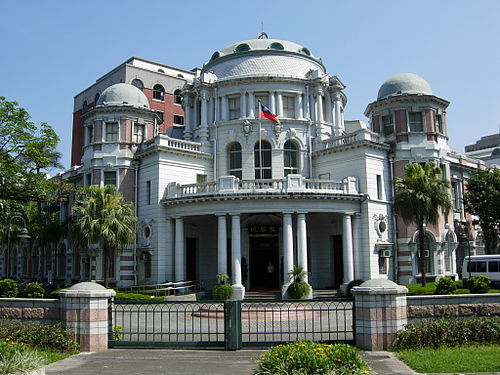
The Taipei Prefecture Office (台北州廳), completed in 1915 as the office of Taihoku-chō (台北廳), was from 1920 the administrative headquarters of Taihoku Prefecture (台北州) during Japanese colonial rule over Taiwan (1895–1945). Designed by prominent colonial architect Matsunosuke Moriyama (森山松之助), the Renaissance-style red brick building served as the seat of government for northern Taiwan — encompassing modern-day Taipei, Keelung, and Yilan. After Japan's surrender in 1945 the building passed to the Republic of China authorities, and since 1958 it has housed the Control Yuan (監察院). It is designated a National Monument (國定古蹟) and is considered one of the best-preserved post-Renaissance colonial buildings in Taiwan.
Images


History
The Taipei Prefecture Office (台北州庁, Taihoku Shūchō) stands at No. 2, Section 1, Zhongxiao East Road in Zhongzheng District, Taipei. Completed in 1915 during the Japanese colonial period, this stately red brick building opened as the office of Taihoku-chō (台北廳) and, after the 1920 administrative reorganisation, served as the administrative centre of Taihoku Prefecture (台北州), which governed the northern areas of Taipei, Keelung, and Yilan until the end of the colonial era.
The building was designed by Matsunosuke Moriyama (森山松之助, 1869–1949), one of the most prolific architects of the Japanese colonial government in Taiwan. Moriyama graduated from the architecture department of Tokyo Imperial University, where he studied under Kingo Tatsuno — himself a student of the British architect Josiah Conder. Moriyama arrived in Taiwan in 1907 (Meiji 40) and served as a technical engineer at the Taiwan Governor-General's Bureau of Construction. Over his career he designed approximately twenty major public buildings in Taiwan, including the final design of the Taiwan Governor-General's Office (now the Presidential Office, revised from Uheiji Nagano's competition entry), the 1911–1913 rebuilding of the Governor-General's Residence (now the Taipei Guest House), and the prefectural halls of Tainan and Taichung.
The Taipei Prefecture Office exemplifies the Renaissance Revival architectural style favoured by the Japanese colonial administration for government buildings. The two-storey structure of steel, concrete, and red brick features distinctive arched windows, white classical columns, ornamental gables, and an elegant mansard roof. The interior includes stained-glass windows, stone entrance pillars, a grand spiral staircase, and elaborately decorated ceilings that reflect the craftsmanship of the Meiji and Taisho eras.
During the fifty years of Japanese rule, the Prefecture Office was the nerve centre for regional administration across northern Taiwan. From 1920 the prefectural governor (知事) operated from this building, overseeing civil governance, police administration, infrastructure development, and wartime mobilisation for the Taipei metropolitan area and surrounding regions. During the Pacific War (1941–1945), the building served as a key node in the colonial wartime administrative apparatus, coordinating civil defence, resource allocation, and military logistics for northern Taiwan.
Following Japan's surrender on 15 August 1945, the building was taken over by the incoming Nationalist Chinese government. In 1958 it became the headquarters of the Control Yuan (監察院), one of the five constitutional branches (五院) of the Republic of China government. The Control Yuan has occupied the building continuously since then, functioning as the government's oversight and auditing institution.
A major multi-year restoration project returned the building to its original splendour, making it one of the best-preserved post-Renaissance colonial government buildings in Taiwan. The building was designated a National Monument (國定古蹟) on 30 July 1998, recognising its exceptional architectural and historical significance. Today it stands at the prominent intersection of Zhongxiao East Road and Zhongshan South Road — a location that during the Japanese era faced the Sansen-dōro (三線路, "three-lane road") boulevard — as an enduring testament to the colonial administrative infrastructure that shaped modern Taiwan.
Categories
Related themes
Sources
- 總統府 (臺灣) - 維基百科Website
- 臺北州廳 - 維基百科Website