Forced Labour & Prisoners of War
強制労働と捕虜
Sites of wartime labour mobilisation, POW camps and detention.
History
This theme covers the camps, work sites and memorials connected with wartime labour mobilisation, Allied prisoners of war and internment. To fill the labour gap created by conscription, wartime Japan mobilised Korean and Chinese labourers and Allied prisoners of war for mines, factories, harbours and construction, and held prisoners and enemy civilians in camps across the empire. The theme includes sites whose interpretation remains contested.
Labour mobilisation from Korea to Japan proper began in 1939 and took three forms over time: "recruitment" by companies (from 1939), "official mediation" through the Government-General's administration (from 1942) and "requisition" under the National Requisition Ordinance (from 1944). Estimates of the numbers differ among statistics and studies but are generally put at several hundred thousand, most assigned to coal and metal mines, construction and munitions plants. For Chinese labourers, a cabinet decision of 1942 authorised their introduction; a report compiled by the Japanese Foreign Ministry after the war records that 38,935 were brought to 135 work sites in Japan and 6,830 died. The uprising of Chinese labourers at the Hanaoka mine in Akita on June 30, 1945 is the best-known case. According to research by a Japanese citizens' group, about 36,000 Allied prisoners were brought to Japan proper; there were about 130 camps in the country at the end of the war, and about 3,500 prisoners died in captivity there.
This history matters because it shows how total-war mobilisation crossed national and ethnic lines and became a focus of postwar responsibility. Mistreatment of prisoners was the main charge in the Class B and C war crimes trials, and compensation for labour mobilisation is still at issue. The Japanese government holds that claims were settled by the 1965 Japan–Korea Claims Agreement and other arrangements and disputes the application of the term "forced labour"; South Korea's Supreme Court ordered Japanese companies to pay compensation in 2018; Chinese plaintiffs lost in Japanese courts, though some companies reached settlements. The degree of coercion varied by period and case, and this site records what can be documented for each place and notes where interpretation is disputed.
Under this theme visitors will find the sites of POW camps and dormitories, mine entrances and related works, tunnels and underground factories built by labourers, foreign and Commonwealth war cemeteries, and memorials erected by local governments, companies, citizens' groups or bereaved families. At many sites nothing remains from the period apart from a monument.
Related sites (50)

Matsushiro Underground Imperial Headquarters
松代大本営地下壕
A massive underground bunker complex built in 1944-1945 beneath three mountains in Matsushiro, Nagano, intended to relocate Japan's Imperial government in the event of an Allied invasion.
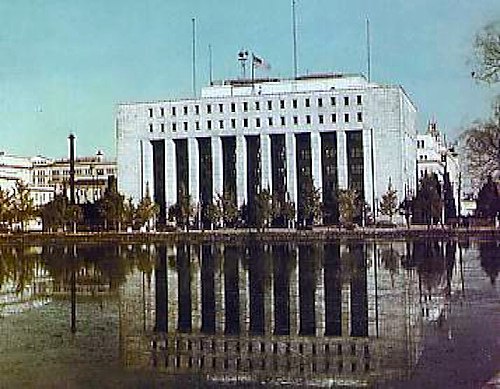
Dai-ichi Life Insurance Building (GHQ SCAP Headquarters)
第一生命館(GHQ総司令部)
The Dai-ichi Life Insurance Building in Tokyo served as General Douglas MacArthur's SCAP headquarters from 1945 to 1952, overseeing the occupation and reconstruction of Japan.

Sugamo Prison Site (Sunshine 60)
巣鴨プリズン跡(東池袋中央公園)
Sugamo Prison, originally built in 1895, was commandeered by Allied occupation forces after WWII to hold suspected war criminals awaiting trial before the International Military Tribunal for the Far East. On December 23, 1948, seven Class-A war criminals — including former Prime Minister Hideki Tojo — were executed by hanging here. A total of 60 war criminals were executed at the site. The war-criminal prison closed in 1958 (1962 by some accounts); the buildings were demolished in 1971 and replaced by the Sunshine City commercial complex (anchored by the 240-meter Sunshine 60 skyscraper) which opened in 1978. A small stone monument inscribed "Pray for Eternal Peace" (永久平和を願って) stands in adjacent Higashi-Ikebukuro Central Park, near the former gallows location.

Ofuna POW Camp Site
大船捕虜収容所跡
A secret Imperial Japanese Navy interrogation center established in April 1942 near Kamakura, Kanagawa Prefecture, where high-value Allied prisoners of war — including downed aviators and submarine commanders — were held and interrogated outside the protections of the Geneva Convention. The camp was never reported to the International Red Cross and was known among inmates as the "Torture Farm." Notable prisoners included Louis Zamperini, Gregory "Pappy" Boyington, and Richard O'Kane. An estimated 500 to 1,000 prisoners passed through the facility before its liberation on 21 August 1945.

Maizuru Repatriation Memorial Museum
舞鶴引揚記念館
A memorial museum in Maizuru, Kyoto Prefecture, commemorating the 664,531 Japanese military personnel and civilians repatriated through the Port of Maizuru between 1945 and 1958, primarily from Soviet forced-labor camps in Siberia. In 2015, 570 items from its collection were inscribed on the UNESCO Memory of the World Register.

Hashima Island (Gunkanjima / Battleship Island)
端島(軍艦島)
An abandoned island off Nagasaki known for its undersea coal mines operated by Mitsubishi. During WWII, mobilized Korean workers and forcibly transported Chinese laborers were forced to work in brutal conditions in the mines. The island reached a peak population of 5,259 in 1959 and was abandoned in 1974. Inscribed as a UNESCO World Heritage Site in 2015 as part of Japan's Meiji Industrial Revolution sites, though its recognition remains controversial due to Japan's insufficient acknowledgment of forced labor history.

Miike Coal Mines (Manda Pit)
三池炭鉱(万田坑)
One of Japan's largest coal mines, operated by Mitsui from 1889 to 1997. The Manda Pit, with Japan's largest vertical shafts, was a core production site from 1902 to 1951. During WWII, thousands of conscripted Korean civilians, Chinese forced laborers, and Allied POWs were compelled to work in the mines under brutal conditions. Inscribed as a UNESCO World Heritage Site in 2015 as part of Japan's Meiji Industrial Revolution sites.

Former 11th Division Headquarters (Nogi Museum), Zentsuji
旧陸軍第十一師団司令部(乃木館)
The headquarters of the Imperial Japanese Army 11th Division, completed in 1898 (Meiji 31) in Zentsuji, Kagawa Prefecture — the only divisional headquarters on the island of Shikoku. The Renaissance-style Western building with plastered walls and a hipped-and-gabled tile roof was the command post of General Nogi Maresuke, who served as the first divisional commander from 1898 to 1901. The 11th Division recruited soldiers from all four Shikoku prefectures and fought in the Russo-Japanese War (Battle of Port Arthur and Mukden under Nogi's Third Army), fought at Shanghai in 1937 and was stationed in Manchuria from 1938, and returned to Shikoku in April 1945 for homeland defense of Tosa Bay. The Zentsuji garrison also housed one of the first Allied POW camps in the Japanese Home Islands (January 1942), holding American servicemen captured on Guam and Wake Island. Today the building serves as the Nogi Museum (乃木館) within JGSDF Camp Zentsuji, home of the 14th Brigade. Remarkably, the original headquarters, red-brick armories, barracks, and the adjacent Kaikosha officers' club (Important Cultural Property, 1903) all survive in situ — an exceptionally rare ensemble of Meiji-era military architecture still in active use.

Sagami Naval Arsenal Ruins
相模海軍工廠跡
Ruins of the Imperial Japanese Navy's dedicated chemical weapons and pyrotechnics arsenal, established in May 1943 in Samukawa Town, Kanagawa Prefecture. The facility was promoted from the Chemical Research Division of the Naval Technical Research Institute (Hiratsuka) to enable mass production of mustard gas (yperite) bombs, gas masks, and incendiary ordnance. At peak capacity over 3,500 workers — including conscripted laborers, Women's Volunteer Corps members, and mobilized students — operated within the 700,000 m² compound. In 2002, buried mustard gas bottles were discovered at the former site during expressway construction, injuring 11 workers and confirming the enduring contamination legacy.

Miyakonojo Airfield Ruins (East & West)
都城飛行場跡(都城東・西飛行場)
Site of two Imperial Japanese Army airfields in southern Kyushu from which 79 Shinbu (Army special attack) pilots flew Ki-84 Hayate fighters on 17 kamikaze sorties against the U.S. fleet off Okinawa between April 6 and July 1, 1945. The West Airfield (built 1934, expanded to 1,200 m runway by 1945) launched the first mission on April 6; after devastating air raids on April 27–28 destroyed it, operations shifted to the East Airfield (built 1944 on converted rice paddies by the Navy, later transferred to Army use). Today, stone monuments at both former airfield sites and the Hayate Shinbu Special Attack Corps Memorial in Toshima Park (former Army cemetery) preserve the memory of the young pilots, most aged 18–23, who never returned.

Yosami Radio Transmitting Station
依佐美送信所
One of the world's largest VLF (Very Low Frequency) radio transmitting stations, built in 1929 in Kariya, Aichi Prefecture with eight 250-meter steel towers and German-made Telefunken high-frequency generators. The station established Japan's first wireless communications with Europe and was employed by the Imperial Japanese Navy during WWII for submarine communications. It is believed to have relayed the coded Pearl Harbor attack order "Niitakayama Nobore 1208" via VLF on December 2, 1941. After the war, the station was requisitioned by the US Navy and operated until 1993. The towers were demolished in 1997 and station buildings in 2006. The site is now Floral Garden Yosami, with a memorial museum preserving the original transmitting equipment. Recognized as an IEEE Milestone in 2009.

Mitsubishi Nagoya Engine Works (Daiko Plant)
三菱重工業名古屋発動機製作所(大幸工場)
Japan's largest aero-engine production complex during WW2, located in Higashi Ward, Nagoya. Established on July 1, 1938, when the engine division was separated from the Mitsubishi Nagoya Aircraft Works (Oe Plant). The Daiko Plant produced over 40% of all Japanese aircraft engines — a staggering total of 48,996 powerplants including the Mitsubishi Kinsei (Venus), Kasei (Mars), and Zuisei (Auspicious Star) radial engines that powered fighters, bombers, and reconnaissance aircraft across both the Navy and Army. From December 13, 1944, to April 7, 1945, the plant was targeted in seven devastating B-29 precision bombing raids involving over 600 sorties and 1,700+ tons of ordnance, killing more than 2,600 factory workers, mobilized students, and volunteer corps members. The factory was completely destroyed. The site is now occupied by Vantelin Dome Nagoya (formerly Nagoya Dome), built in 1997 on the former factory grounds.

Former Ministry of Finance Building (Current MOF Headquarters)
旧大蔵省庁舎(現財務省本庁舎)
The former Ministry of Finance headquarters in Kasumigaseki, Chiyoda Ward, Tokyo, served as the nerve center of Japan's wartime economic control apparatus. Construction began in 1934 under architect Okuma Yoshikuni of the Ministry of Finance Construction Bureau, but was interrupted by the Second Sino-Japanese War. The building reached provisional completion in 1940 and official completion in 1943. Its robust reinforced concrete structure with protective layers on the roof allowed it to survive the devastating Tokyo air raids of 1945, while many buildings in the area — including the German Embassy in nearby Nagatachō — were destroyed. The surviving exterior walls were retained and incorporated into the postwar restoration. After being requisitioned by GHQ as U.S. military offices and barracks from 1945 to 1955, the building was returned to Japan and underwent extensive renovation through 1963. It remains in active use as the Ministry of Finance and National Tax Agency headquarters, and underwent major base-isolation seismic retrofitting between 2015 and 2020.

Former Home Ministry Site (Central Government Building No. 2)
旧内務省跡(中央合同庁舎第2号館)
The Ministry of Home Affairs (内務省, Naimu-shō) was the most powerful cabinet ministry of the Empire of Japan, controlling police, civil administration, Shinto affairs, public works, and local government from 1873 to 1947. During WWII it served as the nerve center of domestic control, operating the Special Higher Police (特高警察, Tokkō) for thought-crime suppression, administering the Air Defense General Headquarters (防空総本部) for civilian air-raid preparedness, and enforcing wartime mobilization of the populace. Its Kasumigaseki headquarters, a reinforced-concrete building completed in 1933 (Shōwa 8), was demolished after the ministry's forced dissolution by GHQ/SCAP on December 31, 1947. The site is now occupied by Central Government Building No. 2 (中央合同庁舎第2号館), housing the Ministry of Internal Affairs and Communications, National Police Agency, and other agencies — the direct bureaucratic successors of the wartime Home Ministry.

Mitsui Main Building
三井本館
The Mitsui Main Building (三井本館) is a seven-storey neoclassical office building in Nihonbashi-Muromachi, Chuo Ward, Tokyo, completed in 1929 as the headquarters of the Mitsui Zaibatsu — the largest and oldest of Japan's four great zaibatsu conglomerates. Designed by the American firm Trowbridge & Livingston in Beaux-Arts style after the previous building was destroyed in the 1923 Great Kanto Earthquake, it served as the nerve center of Mitsui's wartime economic empire encompassing some 270 companies involved in banking, trading, mining, shipbuilding, and munitions. During WWII, Mitsui played a central role in Japan's wartime economic control system, channeling resources for military procurement, expanding into occupied territories, and employing forced labor including Allied POWs. Following Japan's surrender, GHQ ordered the dissolution of Mitsui as part of zaibatsu dismantlement. Designated a National Important Cultural Property in 1998, the building today houses Mitsui Fudosan headquarters and the Mitsui Memorial Museum.

Yoshimi Hyakuana (Underground Munitions Factory Ruins)
吉見百穴(地下軍需工場跡)
A nationally designated historic site in Yoshimi Town, Saitama Prefecture, comprising 219 lateral cave tombs (yokoana) carved into a tuff hillside during the Kofun period (6th–7th century). In 1944–1945, the Imperial Japanese military commandeered the site to construct a massive underground factory for the Nakajima Aircraft Company, intended to produce aircraft engines safe from American air raids. An estimated 3,000 to 3,500 Korean laborers, working in round-the-clock shifts, excavated what is reported as approximately 8.4 kilometers of interconnected tunnels in a grid pattern beneath and around the ancient tombs, destroying over 10 designated cave tombs in the process. The factory never reached full production before Japan's surrender in August 1945. Today, visitors can view both the ancient burial caves and the sealed entrances to the wartime tunnel network—a striking juxtaposition of 1,400-year-old funerary archaeology and 20th-century wartime industrial desperation.

Kinkaseki POW Camp (Jinguashi Allied POW Memorial Park)
金瓜石捕虜収容所
The Kinkaseki Prisoner of War Camp was one of the most brutal Japanese POW camps in colonial Taiwan (Formosa), operational from November 1942 to March 1945 at Kinkaseki (present-day Jinguashi), Ruifang District, New Taipei City. Over 1,100 British Commonwealth and Allied prisoners — predominantly British, with Australian, Canadian, Dutch, and American servicemen — were forced to perform gruelling slave labour deep inside the adjacent copper mine under extreme conditions including temperatures exceeding 40°C, starvation rations, frequent beatings, and no safety provisions. Of the approximately 430 Allied POW deaths across all fourteen Japanese camps on Taiwan, the majority occurred at Kinkaseki. The camp closed in March 1945 when Allied naval interdiction made ore shipment to Japan impossible, and surviving prisoners were relocated to Kukutsu camp. The site lay forgotten until its rediscovery in 1990. On 23 November 1997, an international memorial was dedicated on the original camp grounds, and in 2011 a bronze "Mates" sculpture depicting two emaciated prisoners was unveiled. The memorial park — now known as the Taiwan POW Memorial and Peace Park — includes a 56-foot Wall of Names listing all POWs by rank and origin.

Shirakawa POW Camp (Taiwan Camp No. 4)
白河捕虜収容所(臺灣俘虜収容所第四分所)
Shirakawa POW Camp (Taiwan POW Camp No. 4) was a Japanese prisoner-of-war camp established in June 1943 at the former Neijiao Army Exercise Ground (內角陸軍演習所) in Baihe District, Tainan, colonial Taiwan. Known as the "officers' camp," it held 300–500 Allied prisoners — predominantly senior military officers and colonial officials from the United States, United Kingdom, Netherlands, and Australia — although the very highest-ranking captives held at Karenko, the group of Lt-Gen Arthur Percival (the British commander who surrendered Singapore) and governors such as Sir Shenton Thomas (Straits Settlements), are recorded as having been sent to Taihoku Camp No. 5 rather than to Shirakawa. Transferred primarily from Karenko (Hualien) Camp, prisoners were forced to perform agricultural labour on starvation rations. The camp served as a de facto hospital camp from late 1944 after most of the senior officers were transferred to Manchuria in the autumn of 1944. The camp operated until August 1945 and was liberated following Japan's surrender. In November 2013, the Taiwan POW Camps Memorial Society dedicated a memorial stone at the site entrance. Today the former camp grounds remain under military control as the Neijiao Military Camp (內角營區), now the Army Southern Region Testing and Evaluation Center.

Huwei Sugar Factory Dormitories
虎尾糖廠宿舎群
Japanese colonial-era sugar factory dormitory complex in Huwei, Yunlin County, Taiwan, whose buildings are said to have been used in the final months of World War II to lodge special attack (kamikaze) pilots from the nearby Huwei Naval Airfield, although the sources consulted do not document this. The Huwei Naval Air Group (虎尾海軍航空隊), established in May 1944 to train roughly 260 flight cadets, was dissolved in February 1945 due to fuel and materiel shortages; its aircraft were then transferred to the Chūsei-tai (忠誠隊) special attack squadron for suicide missions against American ships near Okinawa. The sugar factory's First Official Dormitory (第一公差宿舍, also called Taishunkan / 臺春館), built in 1916, and its surrounding Japanese-style residential quarter are the buildings associated with this account. The dormitory complex (reported as 11 to 12 surviving buildings) was designated a county-level historic monument in 2015.

Remains of Taipei Prison (Huaguang Community Ruins)
台北刑務所跡(華光社区遺構)
The Taipei Prison (臺北刑務所, Taihoku Keimushō) was a major colonial detention facility built by the Japanese Government-General of Taiwan around 1904, modeled on European radial prison designs. Located around present-day Jinshan South Road in Taipei, it served as the primary incarceration site for political prisoners throughout the Japanese colonial period (1895–1945). Following the 1923 "Police Incident" (治警事件), prominent anti-Japanese activists including Chiang Wei-shui (蔣渭水), Lin Youchun (林幼春), Tsai Pei-huo (蔡培火), and Lai He (賴和) were imprisoned here. During WWII, the prison also held captured Allied airmen — on June 19, 1945, fourteen American airmen were executed there after a perfunctory trial, just 57 days before Japan's surrender. After the war, the prison grounds became government dormitories known as the Huaguang Community (華光社區). Sections of the original stone prison wall survive along Jinshan South Road: a north wall of about 90 meters, designated a Taipei City monument in 1998, and a south wall designated in 2013. The walls were constructed using stones recycled from the dismantled Qing Dynasty Taipei City Wall.

Taihoku Prisoner of War Camp No. 6
台北捕虜収容所第六分所
Taihoku Prisoner of War Camp No. 6, located in the Dazhi district of Taipei (then Taihoku), was one of the principal Allied POW camps in Japanese-occupied Taiwan (Formosa) during World War II. Operational from November 1942 to September 1945, the camp held approximately 500 prisoners at any given time — almost entirely British troops, initially of the Royal Artillery and the Indian 11th Division's signals unit, captured at the fall of Singapore and transported aboard the hellship England Maru. The 74 POWs who died in captivity were victims of malnutrition, tropical disease, and harsh forced labor including park and lake construction, farming, and work in bus and railway repair shops. In its final year the camp served as a transit hub for prisoners being shipped to Japan and Manchuria. The site is now occupied by the Republic of China Ministry of National Defense headquarters in Dazhi, where a memorial stele was erected in 2011 by the Taiwan POW Camps Memorial Society.
Yuanlin (Inrin) POW Camp
台湾俘虜収容所員林分所
Allied prisoner-of-war camp operated by the Imperial Japanese Army in the town of Inrin (員林, present-day Yuanlin City), Changhua County (then Taichū Prefecture), Taiwan. The site actually comprised two distinct facilities: the Inrin Camp, opened on 1 July 1944 in an old hotel for approximately 100 sick POWs from the Taichū (Taichung) Camp, which had been evacuated after a typhoon flood; and a Temporary Camp, set up in a local school in November 1944 to house 382 American and British survivors of the hellship Hokusen Maru. The Inrin Camp closed on 5 March 1945, with the remaining 43 prisoners moved to Toroku Camp; the Temporary Camp operated until 16 January 1945 when POWs were shipped onward to Japan. No POW deaths were recorded at the Temporary Camp.

Port of Kaohsiung (Former Takao Harbor)
高雄港(旧打狗港)
Taiwan's largest commercial port and Japan's critical southern resource relay hub during World War II. Originally a shallow lagoon known as Takao (打狗), the port underwent three phases of Japanese colonial harbor construction (1908–1944) that transformed it into a deep-water industrial port. Under the wartime southern advance policy (南進政策), Kaohsiung served as the primary transshipment node for Southeast Asian raw materials — oil, rubber, bauxite, and tin — routed to Japan's home islands. Adjacent zaibatsu factories processed bauxite into aluminum for aircraft production. Complementing the nearby Zuoying Naval Base (左營軍港/高雄警備府), the port itself handled military logistics, troop transport, and supply staging for operations toward the Philippines and Southeast Asia. From October 1944, US carrier and land-based aircraft devastated the harbor in repeated raids; the Japanese Navy ultimately scuttled five large vessels to block the harbor entrance against anticipated American landings. The Enoura Maru POW transport was bombed in the harbor on 9 January 1945, killing approximately 300–400 Allied prisoners of war.

Jinguashi Mine (New Taipei City Gold Museum)
金瓜石鉱山(黄金博物館)
The Jinguashi Mine (金瓜石鉱山, Kinkaseki kōzan) was one of the largest gold and copper mines in East Asia, located in Ruifang District, New Taipei City, Taiwan. Placer gold was found in the Keelung River in 1890 and the Jinguashi ore body in 1893, during the late Qing dynasty, and under Japanese colonial rule (1895–1945) the mine came to be known as the foremost precious-metal mine in Asia and was Taiwan's leading copper producer. Operated successively by the Tanaka Group, Ushiroku Shintarō's Kinkaseki Mining Company (from 1925) and Nippon Mining Company (日本鉱業, from 1933), the mine's gold output peaked around 1938 at over 70,000 taels (roughly 2.6 tonnes) a year; copper output in 1936 is given as 7,350 tons or about 11,000 tons depending on the source. During WWII, the mine was designated a critical strategic resource; production was intensified using forced labour from Allied POWs held at the adjacent Kinkaseki POW Camp. US Navy wartime intelligence identified the Kinkaseki gold mines as among Imperial Japan's largest gold sources. Mining continued under the ROC government's Taiwan Metals Mining Company until closure in 1987. The site was transformed into the Gold Ecological Park (黃金博物園區) in November 2004, Taiwan's first ecological museum, now known as the New Taipei City Gold Museum.

Kokan Airfield (Ching Chuan Kang Air Base Predecessor)
公館飛行場(清泉崗基地前身)
Imperial Japanese Navy airfield built on the Dadu Plateau in Taichung, central Taiwan. Originally constructed in 1936 (it was also known as Toyohara Airfield), the facility was requisitioned and expanded by the Navy in 1943 as Kokan Airfield (公館飛行場). By 1944 a satellite runway to the west was under construction. The base was attacked by US Navy carrier aircraft on January 3, 1945. After the war, the site was massively expanded as Kung Kuan Air Base, renamed Ching Chuan Kang (CCK) in 1966, and served as one of the largest US Air Force bases in the Far East during the Vietnam War era. It is now shared between the ROCAF 3rd Tactical Fighter Wing and Taichung International Airport.

Matsuyama Castle & Former IJA 22nd Infantry Regiment Site
松山城・陸軍歩兵第二十二連隊跡
Matsuyama Castle in Ehime Prefecture served as the garrison of the Imperial Japanese Army 22nd Infantry Regiment from the 1880s to 1945. The castle's Sannomaru (third bailey, present-day Shiroyama Park / Horinouchi) housed the regimental barracks, while the Ninomaru (second bailey) became an army hospital. The 22nd Regiment, famed as the "Iyo Nikudan Rentai" (Iyo Flesh-Bullet Regiment) for its ferocity in the Russo-Japanese War, belonged to the 11th Division and later the 24th Division before being annihilated in the Battle of Okinawa in June 1945. Matsuyama also hosted Japan's first prisoner-of-war camp during the Russo-Japanese War (1904–05), where approximately 6,000 Russian POWs were treated with notable humanity. Today the castle grounds are a public park and National Historic Site, with the reconstructed castle tower standing as one of Japan's twelve original castle keeps.

Hanaoka Incident Site & Peace Memorial Museum
花岡事件跡・花岡平和記念館
Site of the 1945 Hanaoka Incident, where 986 Chinese forced laborers under Kajima Corporation suffered brutal conditions at Hanaoka Mine, resulting in 418 deaths. A peace memorial museum now commemorates the tragedy.

Nagoya POW Camp
名古屋俘虜収容所
The Nagoya POW Camp was a Japanese prisoner-of-war camp system established in the Nagoya area of Aichi Prefecture during World War II. The main camp headquarters was set up in Taisei National School in Nagoya, where the Tōkai Army headquarters was then located, on April 5, 1945, as part of a nationwide reorganization of POW administration. The Nagoya camp group administered multiple branch camps across the Chubu region where Allied prisoners — primarily American, British, Dutch, and Canadian servicemen — were subjected to forced labor at munitions factories, railway workshops, and mining operations run by major Japanese corporations including Nippon Sharyo (Nippon Rolling Stock Company), Mitsui Mining, and Ishihara Sangyo. About 3,300 Allied prisoners were held in the eleven branch camps of the Nagoya camp system at the end of the war.

Naoetsu POW Camp (Peace Memorial Park)
直江津捕虜収容所(平和記念公園)
The Naoetsu POW Camp (Tokyo Branch Camp No. 4) was one of the most notorious Allied prisoner-of-war camps in wartime Japan, established in December 1942 in Naoetsu (present-day Jōetsu City), Niigata Prefecture. Of 300 Australian soldiers initially interned, 60 died in captivity from pneumonia, malnutrition, and beriberi brought on by harsh labor, extreme cold, and neglect. The camp later held American, British, and Dutch POWs, reaching 698 inmates by war's end. Eight guards were executed for war crimes — the highest number of death sentences in the Yokohama war crimes trials. The site is now the Naoetsu Peace Memorial Park, opened in 1995 as a symbol of reconciliation between Japan and Australia.

Fukuoka POW Camp Headquarters
福岡俘虜収容所本所
The headquarters of the Fukuoka Prisoner of War Camp system, the largest POW camp network in western Japan during World War II. Established on January 1, 1943, within the Western District Army Headquarters compound in Fukuoka City, the administrative office oversaw more than 30 branch camps across Kyushu and, initially, Yamaguchi and Hiroshima prefectures, where thousands of Allied POWs — American, British, Australian, and Dutch — were forced to labor in coal mines, shipyards, and factories. The camp system was commanded by Colonel Ijyu Sugasawa and later Colonel Manjiro Fukumoto. Sugasawa was executed for war crimes after the war. The headquarters itself held no prisoners, serving purely as the administrative nerve center for the entire Fukuoka camp group.

Sado Gold Mine (Sado Kinzan)
佐渡金山
A historic gold and silver mine complex on Sado Island, Niigata Prefecture, that was one of Japan's largest gold producers. During WWII, an estimated 1,200 to 1,500 Korean laborers were mobilized to work in the mines under harsh conditions. Inscribed as a UNESCO World Heritage Site in 2024, the site remains internationally controversial due to disputes over Japan's acknowledgment of wartime forced labor.

Jōban Coalfield
常磐炭鉱
One of Japan's largest coalfields in Honshu, stretching from southern Fukushima to northern Ibaraki Prefecture. During WWII, the mines were consolidated under government orders and became a critical fuel source for wartime industry, with thousands of Korean forced laborers conscripted to work under brutal conditions as part of the national coal production increase campaign (増産運動).

Aso Mining Yoshikuma Coal Mine Ruins
麻生鉱業吉隈炭鉱跡
Ruins of the Yoshikuma coal mine in the Chikuho coalfield, operated by Aso Mining (麻生鉱業), the family company of the Aso political dynasty. During WWII, approximately 300 Allied POWs (197 Australian, 101 British, 2 Dutch) were held at Fukuoka POW Branch Camp #26 from May to August 1945 and forced to work underground. Two Australian POWs—John Watson and Leslie Edgar George Wilkie—died at the mine. Between 1939 and 1945, an estimated 10,000 Korean laborers were also mobilized to work in Aso Mining's pits under harsh conditions.

Yokohama Commonwealth War Cemetery
横浜英連邦戦死者墓地
Yokohama War Cemetery in Hodogaya-ku is the only Commonwealth War Graves Commission cemetery in Japan, holding the remains of 1,555 Allied servicemen — primarily British, Australian, Canadian, New Zealand, and Indian personnel who died as prisoners of war in Japanese captivity during World War II. Constructed after the war by the Australian War Graves group, the cemetery also houses a shrine containing an urn with the ashes of 335 soldiers, sailors, and airmen from Commonwealth nations, the United States, and the Netherlands. The site, a former children's recreation ground requisitioned in 1946, has been visited by Queen Elizabeth II (1975), Princess Diana (1995), and Prince William (2015).

Chosei Coal Mine Disaster Site
長生炭鉱水没事故跡
Site of the devastating Chosei Coal Mine flooding disaster on February 3, 1942, in which 183 miners perished — 136 of them from the Korean Peninsula — when the ceiling of an undersea tunnel collapsed approximately 1.1 km offshore. Most of the victims' remains still lie in the flooded tunnels beneath the seabed; the first were recovered by divers in 2025. Two concrete ventilation towers ("piya") protruding from the sea mark the location of the submerged mine.

Hiroshima Gokoku Shrine
広島護國神社
A Gokoku Shrine in Hiroshima dedicated to approximately 92,000 war dead from Hiroshima Prefecture, including about 10,000 mobilized students and Women's Volunteer Corps members killed by the atomic bomb on August 6, 1945. Originally founded in 1868 to enshrine Boshin War dead, it was destroyed by the atomic bombing and rebuilt within Hiroshima Castle grounds in 1956. It represents the nationwide Gokoku Shrine system used for wartime spiritual mobilization and remains a key site for peace remembrance ceremonies.

Beitou Public Bathhouse (Beitou Hot Spring Museum)
北投温泉公共浴場(北投温泉博物館)
The Beitou Hot Spring Museum, originally built in 1913 as the Hokutō Public Bathhouse — described as the largest and most lavish public bathhouse of its day, and often called the largest in East Asia — served multiple roles during the Japanese colonial era in Taiwan. During the Russo-Japanese War (1904–05), the Imperial Japanese Army established a convalescent hospital in Beitou for wounded soldiers, and throughout the colonial period the hot spring district functioned as a rest and recuperation area for military personnel, government officials, and elites. During WWII, inns in Beitou are said to have hosted kamikaze pilots for their final meals, and wounded soldiers were treated in the district. Some accounts also associate the area with wartime comfort stations (慰安所). After decades of neglect following Japan's withdrawal in 1945, the bathhouse was restored and reopened as a museum in 1998.

Beitou Museum (Kazan Ryokan)
佳山旅館(北投文物館)
Originally built in 1921 as the Kazan Ryokan, a premier Japanese hot-spring inn in colonial Taiwan, this building is said to have served as a Japanese military officers' club during WWII and to have hosted kamikaze pilots for their final meals before missions. Now the Beitou Museum, it is one of Taiwan's finest preserved two-story wooden Japanese structures and a designated historic monument.

Former Tainan Prison Site
台南刑務所跡
Tainan Prison (台南刑務所) was a major colonial-era correctional facility built in 1904 during the Japanese rule of Taiwan, designed by architect Yamashita Keijiro. Located between the old Xiaonanmen and Xiaoximen gates of Tainan city, it was the second-largest prison in colonial Taiwan after Taihoku Prison, featuring a radial floor plan with five male cell wings and separate women's quarters. The prison was used to incarcerate political prisoners — including those arrested during the 1915 Tapani Incident — as well as common criminals. Inmates were subjected to forced labor in workshops surrounding the cell blocks. In the mid-1980s prison operations relocated to a new facility in Guiren District, and the main compound was demolished from September 1986. Several auxiliary structures survive as designated cultural heritage sites, including the former martial arts hall (要道館), official residences, the prison director's quarters, and dormitory remains, some now repurposed as the Blueprint Cultural and Creative Park (藍曬圖文創園區) near the Tainan Art Museum.

Ama Museum — Peace and Women's Human Rights Museum
阿嬤家―平和と女性人権館
Taiwan's only museum dedicated to the memory of Taiwanese comfort women (慰安婦) forced into sexual slavery by the Imperial Japanese military during World War II. Established by the Taipei Women's Rescue Foundation, the museum opened on December 10, 2016 — International Human Rights Day — and documents the stories of approximately 59 Taiwanese survivors through oral histories, personal artifacts, and audiovisual archives collected over decades of research since 1992.

Nikko Kanaya Hotel
日光金谷ホテル
Japan's oldest surviving resort hotel, established in 1873 in Nikko, Tochigi Prefecture. During World War II, the hotel served as wartime evacuation housing and was requisitioned by GHQ as a special service hotel for U.S. military personnel from October 1945 to February 1952.

Former Outer Garden of Taiwan Shrine (Dazhi)
台湾神社外苑跡(大直)
The outer grounds (gaien) around the Taiwan Gokoku Shrine in the Dazhi area of Taipei — formally the outer garden of the Taiwan Shrine (臺灣神社外苑), within which the Gokoku Shrine stood — encompassing the surrounding military training facilities, sacred forest, and ceremonial approach areas distinct from the main shrine precinct. Planned from the late 1930s as part of the Taiwan Grand Shrine (台灣神宮) relocation project, the outer garden was designed to include martial arts training halls, ceremonial venues, and athletic facilities. During the war, Allied POWs from the nearby Taihoku No. 6 Camp were forced to perform earthworks and railroad construction in this area. The outer grounds now form part of the parkland and military zones surrounding the National Revolutionary Martyrs' Shrine.

Xiluo Bridge
西螺大橋
A landmark bridge spanning the Zhuoshui River in Yunlin County, Taiwan. Designed by Japanese colonial engineers, with the contract let in December 1937 and work begun in 1938, construction was halted during WWII when Japan requisitioned steel materials for the war effort. Thirty piers and two abutments were completed during the Japanese period. The bridge was finally completed in 1953 with US aid, stretching 1,939 meters and hailed at the time as the longest bridge in the Far East.

Kanpu Ferry Terminal Ruins (Shimonoseki Port)
関釜連絡船跡(下関港)
Site of the Shimonoseki-Busan railway ferry terminal that operated from 1905 to 1945, serving as Imperial Japan's primary maritime link to colonial Korea. Over 30 million passengers traversed this route during 40 years of operation, including military personnel bound for the Asian continent, settlers destined for Manchuria, and tens of thousands of Korean forced laborers transported to Japanese factories and mines. A monument and preserved bollards at Kaikyo Yume Plaza mark the former railway pier where the ferries docked. Designated a quasi-railway memorial (準鉄道記念物).

Former Imperial Theatre Site (Marunouchi)
旧帝国劇場跡(丸の内)
Japan's first Western-style theater, the Imperial Theatre (帝国劇場) opened in Marunouchi, Tokyo in 1911 as a symbol of Meiji-era modernization. During WWII, the theater was requisitioned by the Cabinet Information Bureau (内閣情報部) as its office from September 1940, ending theatrical performances. The basement cafeteria was converted into a public congee kitchen for civilians in January 1944 amid severe wartime food shortages. After Japan's surrender, the theater resumed performances in October 1945 and later served entertainment needs during the Allied occupation. The original Renaissance-style building, designed by Yokogawa Tamisuke, was demolished in 1964 and replaced by the current Toho-operated theater designed by Taniguchi Yoshiro, which opened in September 1966.

Seodaemun Prison History Hall
西大門刑務所(ソウル西大門区)
Seodaemun Prison (서대문형무소) was built by the Japanese colonial government in 1908 as Gyeongseong Prison, one of the first modern prisons on the Korean Peninsula. Throughout the Japanese occupation (1910–1945), it served as the primary facility for imprisoning, torturing, and executing Korean independence activists and political dissidents. Notable prisoners included Yu Gwan-sun, who died from torture in 1920 at age 17 after leading protests during the March First Movement, as well as Kim Ku and Ahn Chang-ho. Following the March First Movement of 1919, the prison held approximately 3,000 activists simultaneously. After Korea's liberation in 1945, the prison continued to operate under successive South Korean governments until its closure in 1987. In 1992, Seodaemun Independence Park was established on the grounds, and in 1998 the remaining structures were opened as the Seodaemun Prison History Hall. Eleven of the original 98 buildings are preserved, including underground cells, torture chambers, an execution building, and a watchtower.

Korean Women's Volunteer Labor Corps Memorial (Gwangju)
朝鮮女子勤労挺身隊関連跡(光州)
Memorial and documentation site in Gwangju, South Korea, commemorating the Korean Women's Volunteer Labor Corps (朝鮮女子勤労挺身隊). In 1944–45, young Korean girls — some in their early teens — were recruited through schools and local officials in the Gwangju and South Jeolla region to work in Japanese munitions factories, most notably the Mitsubishi aircraft works in Nagoya; survivors say the promised wages and schooling never materialised. A Statue of Peace (平和の少女像) stands near Gwangju City Hall, and the Gwangju-based Citizens' Group with the Women's Volunteer Labor Corps Grandmothers (근로정신대 할머니와 함께하는 시민모임), founded in 2009, continues to advocate for the victims' recognition and reparations.

Mukden POW Camp (Hoten Camp)
奉天捕虜収容所(奉天俘虜収容所)
A major Japanese prisoner-of-war camp near Mukden (present-day Shenyang), Manchuria, operational from November 1942 to August 1945. The camp held approximately 2,000 Allied POWs in the main camp and its branch camps — including survivors of the Bataan Death March and, at a branch camp, senior commanders such as General Jonathan Wainwright — who were subjected to forced labor in Manchurian factories, starvation rations, brutal cold, and covert medical experiments linked to Unit 731. It is now the Shenyang WWII Allied POW Camp Site Museum, regarded as one of the most representative surviving Japanese POW camp sites.

Huludao Repatriation Port
葫芦島引揚港
The largest postwar Japanese repatriation port in Manchuria. Between May 1946 and August 1948, approximately 1.05 million Japanese civilians and prisoners of war were repatriated from Huludao to Japan, making it the single most significant embarkation point for the mass return of Japanese settlers from Northeast China after World War II.

Fushun War Criminals Management Centre
撫順戦犯管理所
A postwar Chinese facility in Fushun, Liaoning Province, used from 1950 to reform and re-educate Japanese war criminals transferred from Soviet custody. Originally built as a Japanese prison in 1936, it held approximately 1,000 Japanese detainees as well as Manchukuo prisoners including the former emperor Puyi. Known for its "lenient policy" approach, it released all its Japanese prisoners by 1964 and the remaining Manchukuo and Kuomintang prisoners by 1975. Converted into a museum in 1986.