Tsuiki Naval Air Base
築城海軍航空基地

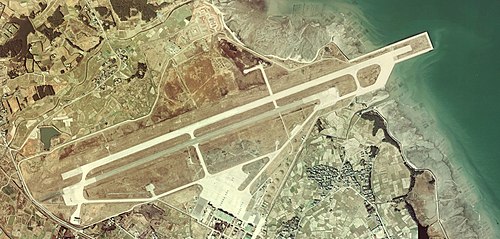
Imperial Japanese Navy air base in northeast Kyushu, completed in 1942 as a carrier fighter pilot training facility. The Tsuiki Naval Air Group trained Zero fighter pilots and later staged kamikaze sorties — on March 18, 1945, six Ginga bombers departed on a special attack mission against the US task force southeast of Kyushu, with five aircraft and 15 crewmen lost. On August 9, 1945, ten fighters scrambled from Tsuiki in a failed attempt to intercept the B-29 carrying the Nagasaki atomic bomb. Reinforced concrete aircraft shelters (entaigo) survive in nearby Inadou, Yukuhashi City, with the Inadou No. 1 Revetment designated a Fukuoka Prefecture historic site in 2023. The base is now JASDF Tsuiki Air Base, home of the 8th Air Wing.
Images


History
Tsuiki Naval Air Base was constructed from December 1939 on the coastal plain straddling present-day Chikujo Town and Yukuhashi City in Fukuoka Prefecture. Mobilized laborers — including workers conscripted from the Korean Peninsula — worked around the clock, and the airfield was completed on October 1, 1942.
The first Tsuiki Naval Air Group (築城海軍航空隊) was established simultaneously as a Third Fleet-attached unit tasked with training replacement carrier fighter pilots. The base featured a simulated aircraft carrier deck on its south side for carrier landing practice, and primarily conducted Zero fighter (A6M) takeoff, landing, and combat training. On February 20, 1944, the unit was redesignated the 553rd Naval Air Group (第五五三海軍航空隊) and redeployed to the Kuril Islands for patrol duties.
A second-generation Tsuiki Naval Air Group was established on March 15, 1944, when training squadrons transferred from the Tsukuba Naval Air Group. This unit was incorporated into the 11th Combined Air Flotilla as an intermediate training formation, preparing student pilots for advanced operational training.
As Japan's strategic situation deteriorated in 1944-1945, the base transitioned to an operational combat role. In August 1944, following the fall of Saipan, construction began on reinforced concrete aircraft shelters (掩体壕, entaigo) in the Inadou district north of the airfield. Approximately 30 shelters of various sizes — both covered and open — were built to disperse and conceal aircraft including Zero fighters, Ginga (P1Y) bombers, and the latest Shiden-Kai (N1K2-J) interceptors.
Kamikaze operations commenced in early 1945. On March 18, 1945, six Yokosuka P1Y Ginga (Frances) bombers of the Shinpu Special Attack Corps Kikusui Unit Ginga Squadron departed Tsuiki. Five aircraft successfully carried out body-crash attacks against American task force vessels southeast of Kyushu; all 15 crewmen perished. Additional special attack sorties followed using various aircraft types, including Type 93 intermediate trainers (Akatombo / Red Dragonfly) fitted with 250 kg bombs.
On August 7, 1945, US Fifth Air Force B-24 Liberator and A-26 Invader bombers attacked the airfield. Two days later, on August 9, 1945, ten fighters scrambled from Tsuiki in an unsuccessful attempt to intercept the B-29 Superfortress 'Bockscar' en route to drop the atomic bomb on Nagasaki.
After Japan's surrender, the airfield lay dormant until the Korean War, when the US Air Force 8th Fighter Group deployed F-51 Mustangs to Tsuiki in August 1950. The base was returned to Japanese control in June 1957 and became JASDF Tsuiki Air Base, currently home to the 8th Air Wing operating F-2A fighters and F-15J interceptors.
The Inadou No. 1 Revetment (稲童1号掩体壕) is the best-preserved wartime shelter, measuring 26.8 meters wide, 5.5 meters high, and 23.5 meters deep, constructed of reinforced concrete in a kamaboko (half-cylinder) shape. Originally built to house medium-sized aircraft such as the Ginga bomber and Type 1 Land Attack Aircraft (G4M), it was designated a Yukuhashi City historic site in 2002 and elevated to a Fukuoka Prefecture historic site (as 海軍築城航空基地稲童掩体) on March 28, 2023. While the Inadou district once had approximately 30 shelters, most were demolished during postwar development; the No. 1 shelter stands as a rare and powerful reminder of the base's wartime role.
Categories
Related themes
Sources
- 築城海軍航空隊 - Wikipedia(日本語)Website
- 海軍築城航空基地稲童掩体 - Wikipedia(日本語)Website
- 築城基地 - Wikipedia(日本語)Website