All historic sites
Sites in the Japanese home islands are shown by default; switch the Region menu to see Taiwan, Korea and Manchuria.
169 sites · page 1 of 8

Bank of Japan Head Office
日本銀行本店
The headquarters of Japan's central bank in Nihonbashi, Chuo Ward, Tokyo. Designed by Tatsuno Kingo and completed in 1896, it is the first major Western-style institutional building in Japan designed by a Japanese architect. During WWII, the Bank of Japan directed wartime monetary policy — financing military expenditure through unlimited government bond purchases, issuing military scrip (gunpyo) for occupied territories, and managing the wartime inflation that devastated the economy. After surrender, it became the center of Allied occupation financial reforms including the Dodge Line stabilization. Designated a National Important Cultural Property in 1974.

Chidorigafuchi National Cemetery
千鳥ヶ淵戦没者墓苑
Chidorigafuchi National Cemetery is Japan's national, non-sectarian tomb for unidentified war dead, located beside the Imperial Palace moat in Chiyoda, Tokyo. Established in 1959 by the Japanese government, the cemetery enshrines approximately 370,485 sets of remains (as of May 2023) of servicemen, military support personnel, and civilians who perished overseas during the Second Sino-Japanese War and World War II but whose identities could not be determined. The central Hexagonal Hall (六角堂, Rokkakudō) houses a gilt bronze urn bestowed by Emperor Shōwa containing symbolic remains from various battlefields, along with a massive five-ton ceramic coffin — one of the largest ceramic objects in the world — fired at 1,700°C from stones gathered across Pacific and Asian war zones. Each spring, the government holds a formal Ceremony of Reverence (拝礼式) attended by members of the Imperial Family, the Prime Minister, and senior officials to honor the unknown dead.
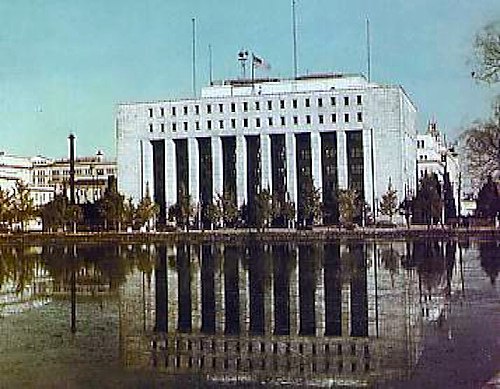
Dai-ichi Life Insurance Building (GHQ SCAP Headquarters)
第一生命館(GHQ総司令部)
The Dai-ichi Life Insurance Building in Tokyo served as General Douglas MacArthur's SCAP headquarters from 1945 to 1952, overseeing the occupation and reconstruction of Japan.

Former Army General Staff Office Site
旧陸軍参謀本部跡
The Imperial Japanese Army General Staff Office (参謀本部, Sanbō Honbu) stood at Miyakezaka, Nagatacho, Chiyoda Ward — the nerve center of all Army operational planning from 1878 to 1941. Designed by Italian architect Giovanni Vincenzo Cappelletti, the Renaissance-style red-brick headquarters was completed in 1881 on the former Ii clan estate overlooking the Imperial Palace moat. Distinct from the Army Ministry (陸軍省) which handled administration, the General Staff held supreme command authority over war plans, intelligence, troop deployments, cartography, and military operations. In December 1941, the General Staff relocated to the Ichigaya compound; the Miyakezaka building was destroyed by Allied bombing in 1945. The site is now occupied by the National Diet Forecourt (国会前庭) and the former Kensei Kinenkan (憲政記念館) area.
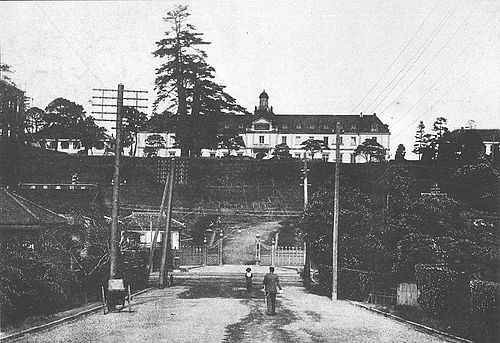
Former Army Ministry Site (Ichigaya Heights)
旧陸軍省跡(市ヶ谷台)
The site of the former Imperial Japanese Army Ministry (陸軍省) at Ichigaya Heights in Shinjuku, Tokyo — the supreme administrative headquarters of the Japanese Army, which moved here from Miyakezaka in December 1941 and remained until 1945. During the Pacific War, it housed the Army Ministry, the Army General Staff Office, and the Imperial General Headquarters Army Section, serving as the nerve center for all wartime military decision-making. On the night of August 14–15, 1945, the compound became the focal point of the Kyūjō Incident (宮城事件), an attempted military coup by army officers seeking to prevent Emperor Hirohito's surrender broadcast.

Former Home Ministry Site (Central Government Building No. 2)
旧内務省跡(中央合同庁舎第2号館)
The Ministry of Home Affairs (内務省, Naimu-shō) was the most powerful cabinet ministry of the Empire of Japan, controlling police, civil administration, Shinto affairs, public works, and local government from 1873 to 1947. During WWII it served as the nerve center of domestic control, operating the Special Higher Police (特高警察, Tokkō) for thought-crime suppression, administering the Air Defense General Headquarters (防空総本部) for civilian air-raid preparedness, and enforcing wartime mobilization of the populace. Its Kasumigaseki headquarters, a reinforced-concrete building completed in 1933 (Shōwa 8), was demolished after the ministry's forced dissolution by GHQ/SCAP on December 31, 1947. The site is now occupied by Central Government Building No. 2 (中央合同庁舎第2号館), housing the Ministry of Internal Affairs and Communications, National Police Agency, and other agencies — the direct bureaucratic successors of the wartime Home Ministry.

Former Imperial Guards Division Headquarters
旧近衛師団司令部庁舎
The Former Imperial Guards Division Headquarters is a red-brick Gothic-style building completed in 1910 in Kitanomaru Park, Tokyo. As the command center of the elite Imperial Guards Division (近衛師団), it was the nerve center of the Kyūjō Incident on the night of August 14–15, 1945, when young army officers led by Major Kenji Hatanaka occupied the Imperial Palace grounds in a failed coup to prevent Japan's surrender. Lieutenant General Takeshi Mori, commander of the 1st Imperial Guards Division, was murdered here when he refused to join the conspiracy. Designated a National Important Cultural Property in 1972, the building formerly housed the National Museum of Modern Art Crafts Gallery (1977–2020).

Former Imperial Household Ministry (Imperial Household Agency)
旧宮内省跡(宮内庁)
The former Imperial Household Ministry (宮内省) building within the Tokyo Imperial Palace grounds served as the administrative center managing all affairs of the Imperial household during WWII. On the night of August 14, 1945, Emperor Showa recorded the Gyokuon-hōsō (Jewel Voice Broadcast) announcing Japan's surrender in a room of this building. Hours later, rebel officers of the Kyūjō Incident stormed the palace searching for the recording discs to prevent the broadcast, but failed to find them. The building now serves as the Imperial Household Agency (宮内庁).

Former Ministry of Commerce & Industry → Ministry of Munitions Site (METI Building)
旧商工省→軍需省跡(経済産業省総合庁舎)
Site of the wartime Ministry of Munitions (軍需省, Gunjushō), established November 1, 1943 by reorganizing the Ministry of Commerce and Industry (商工省) and absorbing the Planning Board's national mobilization functions. Prime Minister Tōjō Hideki concurrently served as the first Minister of Munitions, concentrating wartime production control in his own hands. The ministry directed all military-industrial production — aircraft, ordnance, shipbuilding, and strategic materials — under a centralized command economy. Located at Kasumigaseki 1-3-1, Chiyoda Ward, the site is now occupied by the Ministry of Economy, Trade and Industry (METI) headquarters, the direct bureaucratic successor through the lineage of Commerce Ministry → Munitions Ministry → Commerce Ministry (restored 1945) → MITI (1949) → METI (2001).

Former Ministry of Finance Building (Current MOF Headquarters)
旧大蔵省庁舎(現財務省本庁舎)
The former Ministry of Finance headquarters in Kasumigaseki, Chiyoda Ward, Tokyo, served as the nerve center of Japan's wartime economic control apparatus. Construction began in 1934 under architect Okuma Yoshikuni of the Ministry of Finance Construction Bureau, but was interrupted by the Second Sino-Japanese War. The building reached provisional completion in 1940 and official completion in 1943. Its robust reinforced concrete structure with protective layers on the roof allowed it to survive the devastating Tokyo air raids of 1945, while many buildings in the area — including the German Embassy in nearby Nagatachō — were destroyed. The surviving exterior walls were retained and incorporated into the postwar restoration. After being requisitioned by GHQ as U.S. military offices and barracks from 1945 to 1955, the building was returned to Japan and underwent extensive renovation through 1963. It remains in active use as the Ministry of Finance and National Tax Agency headquarters, and underwent major base-isolation seismic retrofitting between 2015 and 2020.

Former Ministry of Foreign Affairs Building
外務省旧庁舎
The Ministry of Foreign Affairs at Kasumigaseki, Chiyoda Ward, Tokyo, was the nerve center of Japanese wartime diplomacy. The original Western-style building designed by French architect Boinville was completed in 1881 but destroyed in the 1923 Great Kanto Earthquake. The rebuilt ministry served as the site where the Potsdam Declaration was received, translated, and deliberated upon in July–August 1945, and where the Instrument of Surrender was prepared. Foreign Minister Mamoru Shigemitsu departed from this building on September 2, 1945 to sign the surrender aboard USS Missouri. The wartime building was destroyed in the May 25, 1945 air raids on Tokyo. The current complex (North Building 1960, Central/South Buildings 1970) designed by Hideo Kosaka occupies the same Kasumigaseki site.

Former Naval General Staff Headquarters
軍令部跡
The Naval General Staff (軍令部, Gunreibu) was the highest operational command organ of the Imperial Japanese Navy, separate from the Navy Ministry (海軍省) which handled administration. Directly subordinate to the Emperor, the Naval General Staff was responsible for all naval strategy, war planning, and fleet operations, including the planning of the Pearl Harbor attack in 1941. Located in Kasumigaseki, Chiyoda Ward, adjacent to the Navy Ministry, the original building was demolished postwar. A stone monument erected in 1985 at Central Government Building No. 5 marks the site.
Former Navy Ministry
海軍省
The Ministry of the Navy (海軍省, Kaigun-shō) was a cabinet-level ministry of the Empire of Japan responsible for the administrative affairs of the Imperial Japanese Navy from 1872 to 1945. Located in a distinctive red-brick building designed by Josiah Conder in Kasumigaseki, Chiyoda Ward, it served as the administrative nerve center of the IJN throughout WWII, complementing the Army Ministry (陸軍省) at Ichigaya. The building was demolished postwar and replaced by Central Government Building No. 1, which now houses the Ministry of Agriculture, Forestry and Fisheries (農林水産省).

Former Navy Owada Communications Unit
旧海軍大和田通信隊(大和田通信所)
The Imperial Japanese Navy's primary signals intelligence and radio interception facility, established in 1936 on the Musashino Plateau straddling Niiza (Saitama) and Kiyose (Tokyo). The Owada Communications Unit intercepted the "Tora Tora Tora" message confirming the Pearl Harbor attack on December 8, 1941, tracked B-29 bomber communications from Tinian and Saipan, noted the aircraft that dropped the atomic bombs on Hiroshima and Nagasaki as unusual planes operating from Tinian, and received the Potsdam Declaration broadcast — symbolically bookending Japan's Pacific War from first strike to final surrender. After 1945 the site was requisitioned by U.S. forces and remains an active American communications facility (USAF Owada Communication Site, FAC 3056) to this day.

Former NHK Tokyo Broadcasting Hall
NHK東京放送会館跡
The former headquarters of NHK (Japan Broadcasting Corporation) in Uchisaiwaicho, Chiyoda, Tokyo, operational from 1938 to 1973. On August 15, 1945, Emperor Hirohito's historic Gyokuon-hōsō (Jewel Voice Broadcast) announcing Japan's surrender was transmitted from Studio 8 (R-208) in this building. During the preceding night, rebel officers of the Kyūjō Incident attempted to seize the building to prevent the broadcast, confining approximately 60 staff members in Studio 1. The building was demolished in 1978 and the site is now occupied by Hibiya City, with a broadcasting memorial monument marking the location.

Former Prime Minister's Official Residence (now PM's Residential Quarters)
旧首相官邸(現・首相公邸)
The former Prime Minister's Official Residence, completed in 1929 in Nagatacho, Chiyoda Ward, Tokyo, served as both the workplace and residence of successive prime ministers through the most turbulent decades of modern Japanese history. Designed by Shimomoto Muraji in an Art Deco style influenced by Frank Lloyd Wright, the building witnessed the May 15 Incident (1932), the February 26 Incident (1936), wartime cabinet meetings under Tojo Hideki and Suzuki Kantaro, and the final deliberations leading to Japan's surrender in August 1945. In 2002, when a new Kantei was built adjacent, the old building was relocated 50 meters south by hikiya (building-moving) technique and renovated into the Prime Minister's Residential Quarters (Kōtei), preserving its 1929 Art Deco appearance.

Former Privy Council Building
旧枢密院庁舎
The former Privy Council Building within the Imperial Palace grounds housed Japan's supreme advisory body to the Emperor (1888–1947). The Privy Council deliberated on and passed the declaration of war against the United States and Britain on December 8, 1941, and approved other critical wartime national policies. The Neo-Renaissance building, completed in 1921, now serves as the Imperial Guard Headquarters.

Gakuto Shutsujin Send-off Site (Former Meiji Jingu Gaien Stadium)
出陣学徒壮行の地(明治神宮外苑競技場跡)
Site of the iconic October 21, 1943 student-soldier send-off ceremony (学徒出陣壮行会), where approximately 25,000 university students marched in heavy rain at the Meiji Jingu Gaien Stadium before being dispatched to the front lines. The event, broadcast live on national radio, symbolized total mobilization as Japan conscripted its university students after revoking their draft deferments. The former stadium was demolished in 1956 and replaced by the National Olympic Stadium (1958), which itself was rebuilt as the current Japan National Stadium (2019). A stone monument, "出陣学徒壮行の地," erected in 1993 near the Sendagaya Gate, commemorates the thousands of students who never returned.

Hiyoshidai Underground Bunker (Keio University)
日吉台地下壕
A vast underground tunnel complex beneath Keio University's Hiyoshi Campus in Yokohama, constructed from July 1944 as the wartime headquarters of the Imperial Japanese Navy Combined Fleet. Usually described as about 2.6 kilometers long (more than 5 kilometers by Keio University's count of all the bunkers) and 30 meters underground, the bunker housed the Combined Fleet Headquarters, Naval General Staff Section 3, the Aeronautical Headquarters, and the Personnel Bureau. From September 1944 until Japan's surrender in August 1945, Admiral Soemu Toyoda, later succeeded by Vice Admiral Jisaburō Ozawa, and the fleet staff directed the battles of Leyte Gulf, Iwo Jima, and Okinawa from these tunnels. Guided tours are offered periodically by the Association for the Preservation of the Hiyoshidai Tunnels.

Ichigaya Memorial Hall
市ヶ谷記念館
Ichigaya Memorial Hall preserves the auditorium of the former Imperial Japanese Army Ministry Building No. 1, which served as the Army Ministry and Imperial General Headquarters during WWII, the courtroom for the International Military Tribunal for the Far East (Tokyo Trials, 1946–1948), and the site of Yukio Mishima's attempted coup and ritual suicide in 1970. The hall was relocated and reconstructed within the Ministry of Defense compound in 2000.

Imperial General Headquarters
大本営
The supreme military command center of the Japanese armed forces during World War II, located in central Tokyo.

Imperial Japanese Army Academy Site (Camp Zama)
陸軍士官学校跡(座間キャンプ)
Site of the Imperial Japanese Army Academy (陸軍士官学校, Rikugun Shikan Gakkō), the principal officer training school for the Imperial Japanese Army, which relocated from Ichigaya, Tokyo to Sagamihara-Zama in 1937. Emperor Hirohito personally named the campus "Sōbudai" (相武台) and attended graduation ceremonies. From 1937 to 1945, approximately 18,476 officer cadets were trained here before being deployed across the Pacific theater. After Japan's surrender in September 1945, the U.S. 1st Cavalry Division occupied the grounds, which subsequently became "Camp Zama." The base remains an active U.S. Army installation today, serving as the headquarters of U.S. Army Japan, while preserving several wartime-era monuments including the restored Sōbudai stone marker and original barracks buildings.

Imperial Japanese Army Nakano School Site
陸軍中野学校跡
Site of the Imperial Japanese Army Nakano School (陸軍中野学校, Rikugun Nakano Gakkō), Japan's primary intelligence and covert operations training academy from 1938 to 1945. Over 2,500 graduates were trained in espionage, sabotage, guerrilla warfare, propaganda, and counterintelligence. Notable alumni include Second Lieutenant Hiroo Onoda, who continued guerrilla operations on Lubang Island in the Philippines until 1974. The original campus at Nakano 4-chome, Tokyo, has been completely redeveloped; a stone monument (陸軍中野学校址碑) stands in the grounds of the Tokyo Metropolitan Police Hospital, with an information panel in adjacent Nakano Shiki no Mori Park.

Imperial Palace / Obunko Annex
皇居・御文庫附属室
The Obunko Annex (御文庫附属室) is an underground bunker within the Fukiage Gardens of the Imperial Palace in Tokyo, constructed by the Imperial Japanese Army in 1941 as a bomb-proof shelter for Emperor Showa. With 3-meter-thick reinforced concrete walls and a total protective layer of 14.3 meters, it was among the strongest air defense facilities in wartime Japan. Its 60-square-meter conference room was the site of the two most consequential meetings of the Pacific War: the Supreme War Direction Council on August 10, 1945, and the Imperial Conference (御前会議) on August 14, 1945, where Emperor Hirohito issued the "Sacred Decision" (聖断, Seidan) to accept the Potsdam Declaration and end the war. The Obunko Annex is not open to the public, as it lies within the restricted Fukiage Gardens; visitors can access the Imperial Palace Outer Gardens (皇居外苑) and view the palace from the Nijubashi Bridge area.