All historic sites
Sites in the Japanese home islands are shown by default; switch the Region menu to see Taiwan, Korea and Manchuria.
104 sites · page 2 of 5

Former NHK Tokyo Broadcasting Hall
NHK東京放送会館跡
The former headquarters of NHK (Japan Broadcasting Corporation) in Uchisaiwaicho, Chiyoda, Tokyo, operational from 1938 to 1973. On August 15, 1945, Emperor Hirohito's historic Gyokuon-hōsō (Jewel Voice Broadcast) announcing Japan's surrender was transmitted from Studio 8 (R-208) in this building. During the preceding night, rebel officers of the Kyūjō Incident attempted to seize the building to prevent the broadcast, confining approximately 60 staff members in Studio 1. The building was demolished in 1978 and the site is now occupied by Hibiya City, with a broadcasting memorial monument marking the location.

Former Prime Minister's Official Residence (now PM's Residential Quarters)
旧首相官邸(現・首相公邸)
The former Prime Minister's Official Residence, completed in 1929 in Nagatacho, Chiyoda Ward, Tokyo, served as both the workplace and residence of successive prime ministers through the most turbulent decades of modern Japanese history. Designed by Shimomoto Muraji in an Art Deco style influenced by Frank Lloyd Wright, the building witnessed the May 15 Incident (1932), the February 26 Incident (1936), wartime cabinet meetings under Tojo Hideki and Suzuki Kantaro, and the final deliberations leading to Japan's surrender in August 1945. In 2002, when a new Kantei was built adjacent, the old building was relocated 50 meters south by hikiya (building-moving) technique and renovated into the Prime Minister's Residential Quarters (Kōtei), preserving its 1929 Art Deco appearance.

Former Privy Council Building
旧枢密院庁舎
The former Privy Council Building within the Imperial Palace grounds housed Japan's supreme advisory body to the Emperor (1888–1947). The Privy Council deliberated on and passed the declaration of war against the United States and Britain on December 8, 1941, and approved other critical wartime national policies. The Neo-Renaissance building, completed in 1921, now serves as the Imperial Guard Headquarters.

Former Second General Army Headquarters
旧陸軍第二総軍司令部跡
The headquarters of the Imperial Japanese Army's Second General Army (第二総軍), established in Hiroshima in April 1945 under Field Marshal Hata Shunroku to coordinate the defense of western Japan against the anticipated Allied invasion (Operation Ketsu-Go). The command was responsible for all military operations across western Honshū, Shikoku, and Kyūshū. On August 6, 1945, the atomic bombing of Hiroshima devastated the headquarters and its subordinate organizations; by some estimates as many as 20,000 military personnel in the city were killed.

Gakuto Shutsujin Send-off Site (Former Meiji Jingu Gaien Stadium)
出陣学徒壮行の地(明治神宮外苑競技場跡)
Site of the iconic October 21, 1943 student-soldier send-off ceremony (学徒出陣壮行会), where approximately 25,000 university students marched in heavy rain at the Meiji Jingu Gaien Stadium before being dispatched to the front lines. The event, broadcast live on national radio, symbolized total mobilization as Japan conscripted its university students after revoking their draft deferments. The former stadium was demolished in 1956 and replaced by the National Olympic Stadium (1958), which itself was rebuilt as the current Japan National Stadium (2019). A stone monument, "出陣学徒壮行の地," erected in 1993 near the Sendagaya Gate, commemorates the thousands of students who never returned.

Hanaoka Incident Site & Peace Memorial Museum
花岡事件跡・花岡平和記念館
Site of the 1945 Hanaoka Incident, where 986 Chinese forced laborers under Kajima Corporation suffered brutal conditions at Hanaoka Mine, resulting in 418 deaths. A peace memorial museum now commemorates the tragedy.

Hashima Island (Gunkanjima / Battleship Island)
端島(軍艦島)
An abandoned island off Nagasaki known for its undersea coal mines operated by Mitsubishi. During WWII, mobilized Korean workers and forcibly transported Chinese laborers were forced to work in brutal conditions in the mines. The island reached a peak population of 5,259 in 1959 and was abandoned in 1974. Inscribed as a UNESCO World Heritage Site in 2015 as part of Japan's Meiji Industrial Revolution sites, though its recognition remains controversial due to Japan's insufficient acknowledgment of forced labor history.

Hashirajima Anchorage
柱島泊地
The primary anchorage of the Imperial Japanese Navy Combined Fleet throughout the Pacific War, located in southern Hiroshima Bay near Hashira Island (柱島), Iwakuni, Yamaguchi Prefecture. From this vast sheltered anchorage, Admiral Yamamoto Isoroku issued the historic "Niitaka Yama Nobore" (Climb Mount Niitaka) order on 2 December 1941 from the bridge of flagship Nagato, signaling the Kido Butai to proceed with the attack on Pearl Harbor. The anchorage witnessed the catastrophic explosion and sinking of battleship Mutsu on 8 June 1943, killing 1,121 crew. Yamato served as Combined Fleet flagship here from February 1942. As Allied air raids intensified in 1945, the fleet dispersed to coves near Kure.

Himeyuri Monument & Himeyuri Peace Museum
ひめゆりの塔・ひめゆり平和祈念資料館
Memorial and museum commemorating the 136 Himeyuri Student Corps members — schoolgirls and teachers mobilized as frontline nurses during the 1945 Battle of Okinawa — who perished in the final weeks of the war.

Hiroshima Peace Memorial (Atomic Bomb Dome)
広島平和記念碑(原爆ドーム)
The iconic ruin of the Hiroshima Prefectural Industrial Promotion Hall, preserved as a memorial to the atomic bombing of August 6, 1945.

Hiroshima Peace Memorial Museum
広島平和記念資料館
The world's foremost museum dedicated to documenting the atomic bombing of Hiroshima on August 6, 1945. Designed by architect Kenzo Tange and opened in 1955, the museum houses artifacts, photographs, and survivor testimonies that convey the catastrophic human cost of nuclear weapons. More than 70 million people have visited since its founding, a mark passed in 2017.

Hiyoshidai Underground Bunker (Keio University)
日吉台地下壕
A vast underground tunnel complex beneath Keio University's Hiyoshi Campus in Yokohama, constructed from July 1944 as the wartime headquarters of the Imperial Japanese Navy Combined Fleet. Usually described as about 2.6 kilometers long (more than 5 kilometers by Keio University's count of all the bunkers) and 30 meters underground, the bunker housed the Combined Fleet Headquarters, Naval General Staff Section 3, the Aeronautical Headquarters, and the Personnel Bureau. From September 1944 until Japan's surrender in August 1945, Admiral Soemu Toyoda, later succeeded by Vice Admiral Jisaburō Ozawa, and the fleet staff directed the battles of Leyte Gulf, Iwo Jima, and Okinawa from these tunnels. Guided tours are offered periodically by the Association for the Preservation of the Hiyoshidai Tunnels.

Ichigaya Memorial Hall
市ヶ谷記念館
Ichigaya Memorial Hall preserves the auditorium of the former Imperial Japanese Army Ministry Building No. 1, which served as the Army Ministry and Imperial General Headquarters during WWII, the courtroom for the International Military Tribunal for the Far East (Tokyo Trials, 1946–1948), and the site of Yukio Mishima's attempted coup and ritual suicide in 1970. The hall was relocated and reconstructed within the Ministry of Defense compound in 2000.

Imperial General Headquarters
大本営
The supreme military command center of the Japanese armed forces during World War II, located in central Tokyo.

Imperial Japanese Army Academy Site (Camp Zama)
陸軍士官学校跡(座間キャンプ)
Site of the Imperial Japanese Army Academy (陸軍士官学校, Rikugun Shikan Gakkō), the principal officer training school for the Imperial Japanese Army, which relocated from Ichigaya, Tokyo to Sagamihara-Zama in 1937. Emperor Hirohito personally named the campus "Sōbudai" (相武台) and attended graduation ceremonies. From 1937 to 1945, approximately 18,476 officer cadets were trained here before being deployed across the Pacific theater. After Japan's surrender in September 1945, the U.S. 1st Cavalry Division occupied the grounds, which subsequently became "Camp Zama." The base remains an active U.S. Army installation today, serving as the headquarters of U.S. Army Japan, while preserving several wartime-era monuments including the restored Sōbudai stone marker and original barracks buildings.

Imperial Japanese Army Nakano School Site
陸軍中野学校跡
Site of the Imperial Japanese Army Nakano School (陸軍中野学校, Rikugun Nakano Gakkō), Japan's primary intelligence and covert operations training academy from 1938 to 1945. Over 2,500 graduates were trained in espionage, sabotage, guerrilla warfare, propaganda, and counterintelligence. Notable alumni include Second Lieutenant Hiroo Onoda, who continued guerrilla operations on Lubang Island in the Philippines until 1974. The original campus at Nakano 4-chome, Tokyo, has been completely redeveloped; a stone monument (陸軍中野学校址碑) stands in the grounds of the Tokyo Metropolitan Police Hospital, with an information panel in adjacent Nakano Shiki no Mori Park.

Imperial Japanese Naval Academy, Etajima
海軍兵学校
The Imperial Japanese Naval Academy at Etajima, established in 1888, was the primary officer training institution of the Imperial Japanese Navy, comparable to the US Naval Academy at Annapolis.

Imperial Palace / Obunko Annex
皇居・御文庫附属室
The Obunko Annex (御文庫附属室) is an underground bunker within the Fukiage Gardens of the Imperial Palace in Tokyo, constructed by the Imperial Japanese Army in 1941 as a bomb-proof shelter for Emperor Showa. With 3-meter-thick reinforced concrete walls and a total protective layer of 14.3 meters, it was among the strongest air defense facilities in wartime Japan. Its 60-square-meter conference room was the site of the two most consequential meetings of the Pacific War: the Supreme War Direction Council on August 10, 1945, and the Imperial Conference (御前会議) on August 14, 1945, where Emperor Hirohito issued the "Sacred Decision" (聖断, Seidan) to accept the Potsdam Declaration and end the war. The Obunko Annex is not open to the public, as it lies within the restricted Fukiage Gardens; visitors can access the Imperial Palace Outer Gardens (皇居外苑) and view the palace from the Nijubashi Bridge area.

Imperial Steel Works (Yawata Steel Works)
官営八幡製鐵所
Japan's first integrated government-run steelworks, established in 1901 in Kitakyushu. During WWII it produced 24% of Japan's rolled steel, making it the primary target of the first B-29 strategic bombing raid on the Japanese home islands on June 15, 1944 (Operation Matterhorn). Now a UNESCO World Heritage Site as part of the Sites of Japan's Meiji Industrial Revolution.
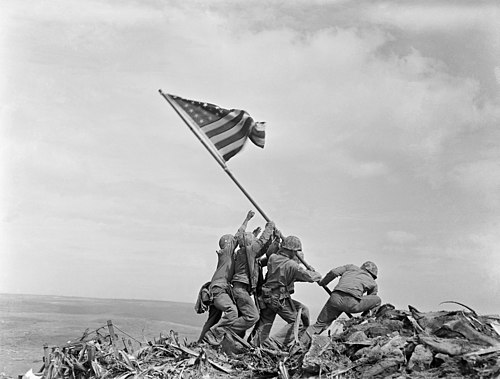
Iwo Jima (Battle of Iwo Jima)
硫黄島
Iwo Jima was the site of one of the bloodiest battles of the Pacific War (February 19 – March 26, 1945). Defended by 21,000 Japanese troops under Lt. General Kuribayashi Tadamichi using an innovative network of tunnels and fortified positions, the island was stormed by U.S. Marines in a 36-day battle that killed roughly 18,000–20,000 Japanese and nearly 7,000 Americans. The iconic flag-raising on Mount Suribachi remains one of the most famous images of World War II.

JMSDF Sasebo Museum "Sail Tower" (Former Sasebo Naval Arsenal Site)
海上自衛隊佐世保史料館(セイルタワー)
The JMSDF Sasebo Museum, nicknamed "Sail Tower" for its sail-shaped rooftop, is a seven-story naval history museum located in Sasebo, Nagasaki Prefecture. Its lower two floors incorporate the restored 1898 Sasebo Suikosha (Naval Officers' Club), making it both a functioning museum and a preserved Meiji-era naval heritage structure. The museum houses approximately 4,400 artifacts spanning from the establishment of Sasebo Naval District (1889) through the Imperial Japanese Navy era — including the Sasebo Naval Arsenal's peak wartime operations employing 50,000 workers — to the modern Japan Maritime Self-Defense Force. Opened on March 10, 1997, it stands on the grounds of the former Sasebo Chinjufu (Naval Station), which was one of four principal naval districts that defended the Japanese home islands.

Kadena Air Base (Former Japanese Middle Airfield)
嘉手納飛行場
Originally the Imperial Japanese Army's Middle Airfield (中飛行場), urgently constructed from May 1944 on forcibly requisitioned land in Kadena, Okinawa. Captured by the U.S. 7th Infantry Division on April 1, 1945 — the first day of the Battle of Okinawa — it was rapidly rebuilt and expanded into what became the largest U.S. Air Force installation in the Pacific. Known as the "Keystone of the Pacific," Kadena remains an active U.S. military base; together with the adjoining ammunition storage area it occupies about 82% of Kadena Town's land area, serving as a potent symbol of the continuity of American military occupation in Okinawa.

Kaiten Memorial Museum
回天記念館
Museum on Ozushima island dedicated to the kaiten human torpedo program — the Imperial Japanese Navy's underwater special attack weapon. Located at the site of the first and best-preserved kaiten training base (est. September 1944), the museum houses over 1,000 artifacts including farewell letters, uniforms, and personal belongings of the young pilots who perished. Access requires a ferry from Tokuyama Port.

Kakamigahara Airfield (Gifu Air Base)
各務原飛行場
Japan's second-oldest military airfield, established in 1917 in Gifu Prefecture. On April 1, 1939, test pilot Katsuzo Shima made the maiden flight of the Mitsubishi A6M Zero prototype here — the fighter that would become Imperial Japan's most iconic warplane. During WW2, the adjacent Kawasaki aircraft factory mass-produced Ki-61 Hien fighters at peak rates of 200 per month. The airfield survived devastating B-29 raids in 1945 and today serves as JASDF Gifu Air Base, with the Gifu-Kakamigahara Air and Space Museum preserving the site's aviation heritage.